Darfix

DFX Videos

Latest approved user videos.

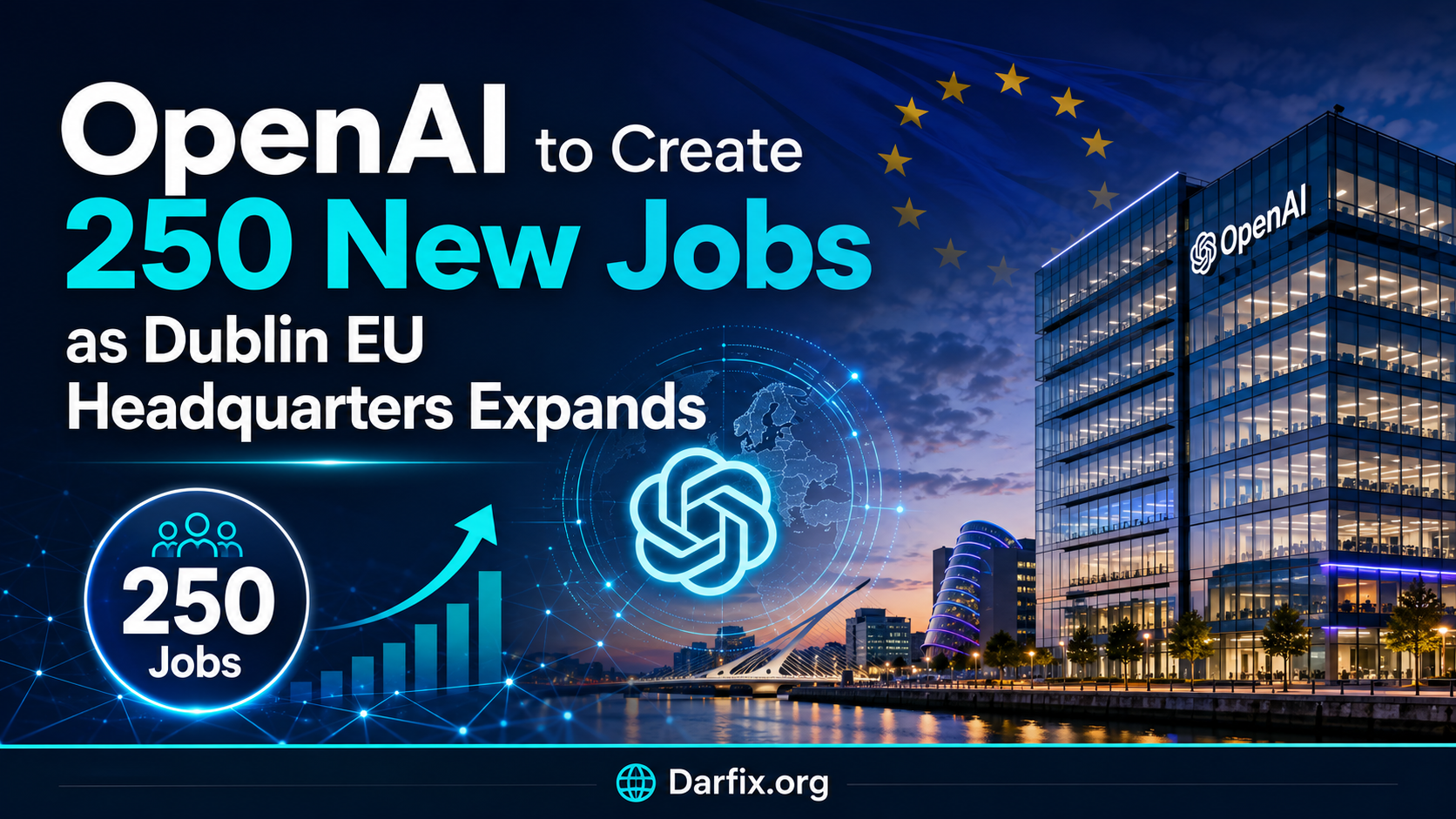
OpenAI to Create 250 New Jobs as Dublin EU Headquarters Expands
OpenAI has announced a major expansion of its European operations, with plans to create 250 additional jobs in Dublin and move its European Union headquarters into a significantly larger office. The company has leased the Tropical Fruit Warehouse in Dublin’s Docklands. The new European headquarters will cover approximately 88,000 square feet, equivalent to about 8,000 square metres, and is expected to become operational toward the end of 2026. OpenAI’s Dublin Workforce Will Grow to 350 OpenAI currently employs more than 100 people in Dublin. By recruiting another 250 employees over the next two years, the company expects its workforce in the Irish capital to reach approximately 350 people. The new positions will not be limited to artificial-intelligence research. OpenAI says it plans to recruit employees across engineering, user operations, sales and go-to-market teams, human resources, finance, privacy, legal affairs, corporate security and workplace operations. This broader recruitment strategy indicates that Dublin will function as more than a regional sales office. It will support customers, developers, business operations and the company’s wider expansion throughout Europe. A New European Headquarters OpenAI selected the Tropical Fruit Warehouse as the new home of its European Union headquarters. The historic building is located in Dublin’s Docklands, an area closely associated with international technology and financial companies. The larger office will provide space for OpenAI’s expanding workforce, customer collaboration, developer engagement and demonstrations of the company’s technology. OpenAI expects to relocate its Dublin team to the building during late 2026. The company first announced its Dublin operation in 2023. Since then, the office has become OpenAI’s principal base inside the European Union, while the company has continued establishing teams and offices in other major European cities. Why OpenAI Chose Dublin Dublin already hosts the European headquarters or major operations of several American technology companies, including Google, Meta and Microsoft. Ireland has attracted international companies through its multilingual technology workforce, access to the European market and established multinational business environment. Foreign multinational companies—particularly those operating in technology and pharmaceuticals—employ approximately 11 percent of Ireland’s workforce. The Irish government is increasingly presenting artificial intelligence as an important area for future international investment. OpenAI and IDA Ireland said Ireland’s technology talent, research ecosystem and growing AI expertise contributed to the company’s decision to increase its presence in Dublin. Growing Demand for ChatGPT in Ireland According to the expansion announcement, the number of ChatGPT users in Ireland has grown to more than one million since OpenAI established its European Union headquarters there in 2023. Irish companies use OpenAI technology for activities such as software development, customer service, product creation and business growth. The new headquarters is intended to help OpenAI work more closely with European users, companies and developers as demand for AI products continues to increase. OpenAI also plans to expand its “OpenAI for Ireland” programme. The initiative is focused on helping young developers, startups and small and medium-sized businesses develop practical AI skills and experience. A Significant Announcement for Ireland’s Technology Sector The announcement comes during an uncertain period for technology employment. Some major companies, including Meta and TikTok, have announced reductions affecting parts of their Irish operations, while OpenAI is moving in the opposite direction by adding hundreds of new positions. The expansion therefore represents an important investment for Dublin and reinforces Ireland’s position as a European base for international technology companies. It may also increase competition for workers with experience in software engineering, AI operations, privacy, legal compliance, customer support and enterprise technology. What the Expansion Means for OpenAI The Dublin headquarters will help OpenAI manage its relationships with European customers, developers and regulators. Operating inside the European Union requires technology companies to work within detailed rules covering privacy, data protection, digital services and artificial intelligence. Expanding teams in legal affairs, privacy and corporate operations may help OpenAI manage these responsibilities while serving a rapidly growing European market. This is an inference from the announced job categories and the role of the Dublin office; OpenAI did not describe every regulatory responsibility assigned to the new employees. How to Apply for the New Positions OpenAI says the newly created Dublin positions will be advertised through its official careers portal. The company already lists roles connected to sales, engineering, support and European operations, with additional openings expected as recruitment progresses. Applicants should review the requirements of each position carefully and apply only through OpenAI’s official recruitment system. Candidates should also be cautious of unofficial advertisements that request money, passwords or sensitive personal information. The Wider European AI Competition OpenAI’s Dublin expansion demonstrates how competition in artificial intelligence now extends beyond building powerful models. AI companies also need engineers, customer-support teams, business specialists, legal experts and infrastructure professionals capable of deploying their products internationally. European countries are competing to attract these companies because AI investment can create specialized employment, support startups and strengthen local technology ecosystems. However, governments must also consider the effects of rapid AI growth on energy demand, employment, privacy and regulation. The long-term value of these investments will depend on whether companies create sustainable employment and help local businesses and workers benefit from the technology. OpenAI’s decision to create 250 new jobs and establish a larger European headquarters is therefore more than a property announcement. It represents a significant expansion of the company’s European operations and another sign that Dublin intends to remain an important centre in the global technology industry.

Technology4d ago
Share:
China Warns of Countermeasures as US Considers Sanctions on AI Companies
Tensions between the United States and China are escalating again—this time over artificial intelligence, model development and access to advanced technology. China’s Ministry of Commerce has accused the United States of attempting to dominate the global AI industry and warned that Beijing could introduce countermeasures if Washington investigates, sanctions or restricts Chinese artificial-intelligence companies. The dispute intensified after senior US officials raised allegations against Beijing-based Moonshot AI, the developer of the Kimi K3 model. American officials claim that some Chinese AI companies may have used outputs from advanced US models to train competing systems through a process known as model distillation. Distillation is a common machine-learning technique in which a smaller or more efficient model learns from the responses of a larger model. The method itself is not necessarily illegal. The central dispute concerns whether companies violated service agreements, intellectual-property protections or technology-export restrictions while collecting the information. US officials have specifically alleged that Moonshot AI used technology connected to Anthropic’s models and gained access to restricted computing infrastructure. Moonshot has denied the accusations and says its progress came from original architectural and engineering improvements. The claims have not yet been established through a completed public legal proceeding. Possible US Restrictions The United States is reportedly considering several responses if officials conclude that violations occurred. Potential measures could include investigations, financial sanctions, tighter controls on advanced chips and the addition of Chinese AI companies to the US Commerce Department’s Entity List. Placement on the Entity List can severely restrict a company’s ability to purchase American hardware, software and other technologies without government authorization. Such restrictions could affect access to advanced AI processors, cloud infrastructure and tools required to train large models. Washington has said it supports competition and open AI development but will not tolerate intellectual-property theft or attempts to bypass technology controls. Chinese officials argue that the allegations are being used to limit competitors and preserve US influence over the global AI market. China Threatens Countermeasures China’s Commerce Ministry rejected the American accusations and said Beijing would take necessary measures to defend the interests of Chinese companies. The ministry described the proposed investigations and restrictions as politically motivated pressure rather than neutral enforcement. However, it did not provide detailed information about the countermeasures China might introduce. Possible responses could involve restrictions affecting technology exports, market access or cooperation with American companies, although no specific action has been formally announced in connection with this dispute. Reuters previously reported that Chinese authorities had also discussed tighter controls on overseas access to some of the country’s most advanced AI models. Those discussions illustrate how both countries increasingly view AI systems, training data and computing infrastructure as strategic national assets. A Wider Technology Rivalry The controversy extends beyond one company or model. The United States and China are competing across advanced semiconductors, cloud computing, robotics, large language models, open-source technology and international AI standards. The United States continues to lead in access to high-end computing infrastructure and several frontier AI systems. Chinese developers, meanwhile, have expanded their influence through efficient models, competitive pricing and the release of open-weight systems that can be adapted by researchers and businesses. China has also promoted itself as a supporter of broader international access to artificial intelligence, while US officials emphasize security, intellectual-property protection and restrictions on sensitive technologies. These competing approaches are influencing how other countries choose AI platforms, governance rules and technology partners. Why Model Distillation Matters Training a frontier AI model requires enormous quantities of data, computing power, engineering expertise and electricity. Using the responses of an existing model can potentially reduce some development costs and accelerate the creation of a competing system. AI companies therefore increasingly monitor how other services access their models and whether automated accounts are collecting large volumes of outputs. At the same time, researchers warn that excessively broad restrictions could harm legitimate research, open-source development and international AI safety cooperation. A Reuters analysis noted that worsening US-China relations could make collaboration on the security risks of advanced AI more difficult. What Happens Next? The immediate future depends on whether the United States launches formal investigations or introduces restrictions against specific companies. If sanctions are imposed, China may respond with trade or technology measures of its own. The dispute could also accelerate efforts by Chinese companies to develop domestic chips, software and independent AI infrastructure. For businesses and developers, the conflict may affect access to models, cloud services, computing hardware and international partnerships. It could also divide the global AI industry into increasingly separate technological ecosystems. The current allegations remain disputed, and no final public determination has established that Moonshot AI illegally copied an American model. The issue should therefore be reported as an ongoing political and technological dispute rather than a confirmed case of theft. Artificial intelligence is becoming more than a commercial technology. It is now a central part of international competition, economic policy and national security—and the latest confrontation between Washington and Beijing demonstrates how quickly technical disagreements can become global political conflicts.
Technology4d ago
Share:
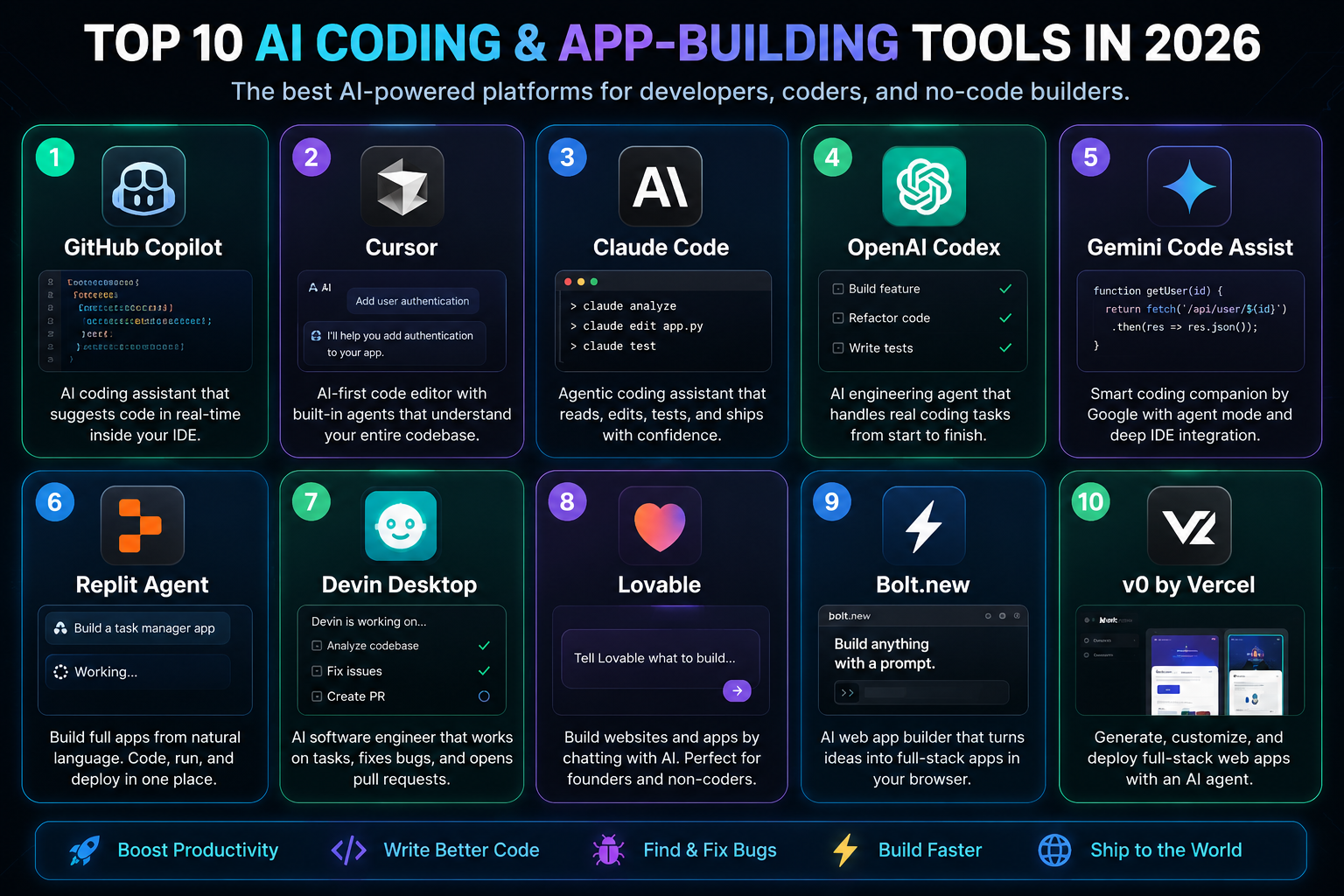
Top 10 AI Coding and App-Building Tools in 2026
Artificial intelligence has transformed software development. In 2026, developers can use AI to write code, understand large projects, find bugs, create tests, complete pull requests and build full-stack applications from written instructions. Some AI coding tools work inside traditional development environments and assist professional programmers. Others can generate complete websites and applications for users who have little or no coding experience. However, these platforms do not all serve the same purpose. A coding agent designed to modify a large repository is different from a conversational app builder designed to create a website from a prompt. The following list presents ten of the most useful AI coding and app-building tools in 2026. The order is an editorial selection based on overall capabilities, accessibility and usefulness for different development workflows rather than a universal scientific ranking. 1. GitHub Copilot GitHub Copilot is an AI development assistant integrated with GitHub and popular code editors. It can suggest individual lines, generate complete functions, explain code, answer questions about a project and assist with software-development tasks. Copilot works with development environments such as Visual Studio Code, Visual Studio, JetBrains IDEs and Neovim. Because it is closely connected to GitHub, developers can use it across coding, repository management, pull requests and command-line workflows. It is a practical choice for developers who want AI assistance without leaving their existing editor and GitHub workflow. 2. Cursor Cursor is an AI-first code editor designed for building and modifying software with coding agents. It can understand project files, search through a codebase, generate new features and make coordinated changes across multiple files. Developers can give Cursor a high-level instruction, review the proposed plan and allow the agent to write or update the required code. It also provides familiar editor features for users who want to continue writing and reviewing code manually. Cursor is particularly useful for web developers, startup teams and programmers who want an AI agent directly inside their primary coding environment. 3. Claude Code Claude Code is Anthropic’s agentic coding tool for terminals, development environments, desktop applications and web-based workflows. It can read a codebase, explain project structure, edit files, run commands, fix bugs, create features and execute tests. Claude Code can also work with GitHub and GitLab workflows, helping developers move from an issue to an implemented and tested pull request. Its ability to work across many files makes it useful for complex refactoring, debugging and understanding unfamiliar repositories. It is best suited to developers who want a powerful coding agent while maintaining visibility over the commands and changes being made. 4. OpenAI Codex OpenAI Codex is a coding agent designed to complete real software-engineering tasks. It can build features, refactor projects, review code, perform migrations, run development workflows and work on several tasks in parallel. Codex can be accessed through ChatGPT, supported development environments, a command-line interface and dedicated applications. Developers can delegate a task to an agent, allow it to work inside an isolated environment and then review the resulting code and changes. It is particularly useful for professional teams that need assistance with complete engineering tasks rather than only short code suggestions. 5. Gemini Code Assist Gemini Code Assist is Google’s AI coding assistant for supported development environments. It can provide inline code completion, generate code from instructions, explain existing files and assist with debugging and development planning. Its agent mode can work through more complex tasks such as fixing bugs, building features and improving test coverage. Gemini can use relevant project files as context to produce responses that are more closely connected to the current codebase. Google also provides Gemini CLI, which brings agentic coding capabilities into the terminal and supports local tools and Model Context Protocol integrations. Gemini Code Assist is especially relevant for developers using Google Cloud, Android, Firebase or other Google development services. 6. Replit Agent Replit Agent allows users to describe an application or website through conversation and have the platform build it automatically. The agent can generate the interface, application logic, database connections and other elements required for a working project. Users can test the result inside Replit, request changes in natural language and deploy the finished application without configuring a separate development environment. Replit Agent is suitable for beginners, entrepreneurs, educators and developers who want to move quickly from an idea to a functional online product. It can generate substantial amounts of code automatically, but users should still inspect security, database structure, performance and error handling before launching an important production application. 7. Devin Desktop Devin Desktop provides a workspace for managing local and cloud-based coding agents. Developers can assign tasks, review progress and allow multiple agents to work on different parts of a project. Its development environment supports activities such as writing code, running commands, investigating edge cases and preparing pull requests. This agent-oriented workflow can be useful for teams that want to delegate several well-defined engineering tasks while developers focus on architectural and product decisions. Devin Desktop is most appropriate for experienced developers and software teams that understand how to review generated changes and validate them before deployment. 8. Lovable Lovable is an AI-powered platform for building websites, applications and digital products through conversation. Users can explain what they want, and the platform generates a functional project that can be refined through additional prompts. It is particularly useful for landing pages, dashboards, internal tools, startup prototypes and database-connected web applications. Users can modify the design, add new functionality and connect their projects to external services. Lovable is a strong choice for founders, designers and non-technical creators who want to develop a working product without manually writing every part of the code. More advanced applications may still require a developer to review authentication, data protection, payment logic and deployment configuration. 9. Bolt.new Bolt.new is a browser-based AI app builder that can generate full-stack websites and applications from written instructions. Users can describe a product, allow the AI to create the interface and code and then continue modifying the result through conversation or a browser-based code editor. Projects can include responsive layouts, application logic and integrations with supported development services. Bolt.new is useful for prototypes, business tools, SaaS concepts, portfolios and interactive web applications. Its combination of natural-language generation and direct code access makes it suitable for both beginners and developers. It can accelerate the first stages of development, but generated projects should be tested carefully before being used for sensitive or high-traffic services. 10. v0 by Vercel v0 is an AI agent from Vercel for designing and building full-stack web applications. Users can generate interfaces, create working prototypes, update content and develop application features through natural-language instructions. The platform is especially strong for modern web interfaces and applications built with technologies commonly used in the Vercel ecosystem. Projects can be connected to GitHub, refined through code and published as live websites. v0 is useful for frontend developers, designers, product teams and founders who want to turn an idea or visual description into a functioning web experience quickly. Which AI Coding Tool Should You Choose? GitHub Copilot is a practical option for developers who want AI suggestions and assistance inside their existing editor and GitHub workflow. Cursor is suitable for developers who want an AI-first code editor with project-wide agents. Claude Code and OpenAI Codex are stronger choices for complex repository tasks, multi-file changes, debugging and complete engineering workflows. Gemini Code Assist is relevant for developers working with Google services or seeking an AI assistant in supported IDE and terminal environments. Replit Agent, Lovable, Bolt.new and v0 are easier options for people who want to build websites and applications from written ideas. They can be particularly valuable for rapid prototyping and testing a product concept. Devin Desktop is more appropriate for experienced engineering teams that want to manage multiple coding agents and delegate several software-development tasks. Can AI Build a Complete Application? Modern AI tools can create impressive prototypes and even produce production-ready components. They can generate interfaces, databases, APIs, authentication systems and deployment configurations. However, creating a reliable commercial application still requires human review. AI-generated code may contain security vulnerabilities, inefficient database queries, incorrect assumptions, unnecessary dependencies or incomplete error handling. Developers should review every important change, run automated and manual tests and confirm that the application protects user information correctly. Important Security Considerations Confidential source code, passwords, API keys and customer information should not be placed into an AI platform without understanding how the service stores and processes submitted data. Generated projects should never contain secret keys directly inside frontend files or public repositories. Authentication, payments, file uploads and administrator permissions require particularly careful testing. Developers should also review the licenses of generated code and third-party packages. AI tools may suggest open-source libraries, but the developer remains responsible for checking their licenses, maintenance status and security history. The Future of AI-Assisted Development AI is making software creation more accessible, but it is not eliminating the need for developers. Instead, the developer’s role is moving toward planning, system design, code review, testing, security and product decision-making. Beginners can now create functional prototypes much faster, while experienced developers can delegate repetitive tasks and focus on more complex engineering problems. The strongest results come from combining AI speed with human judgment. Artificial intelligence can generate the first version, but reliable software still depends on careful architecture, testing, security and continuous maintenance.
Technology4d ago
Share:
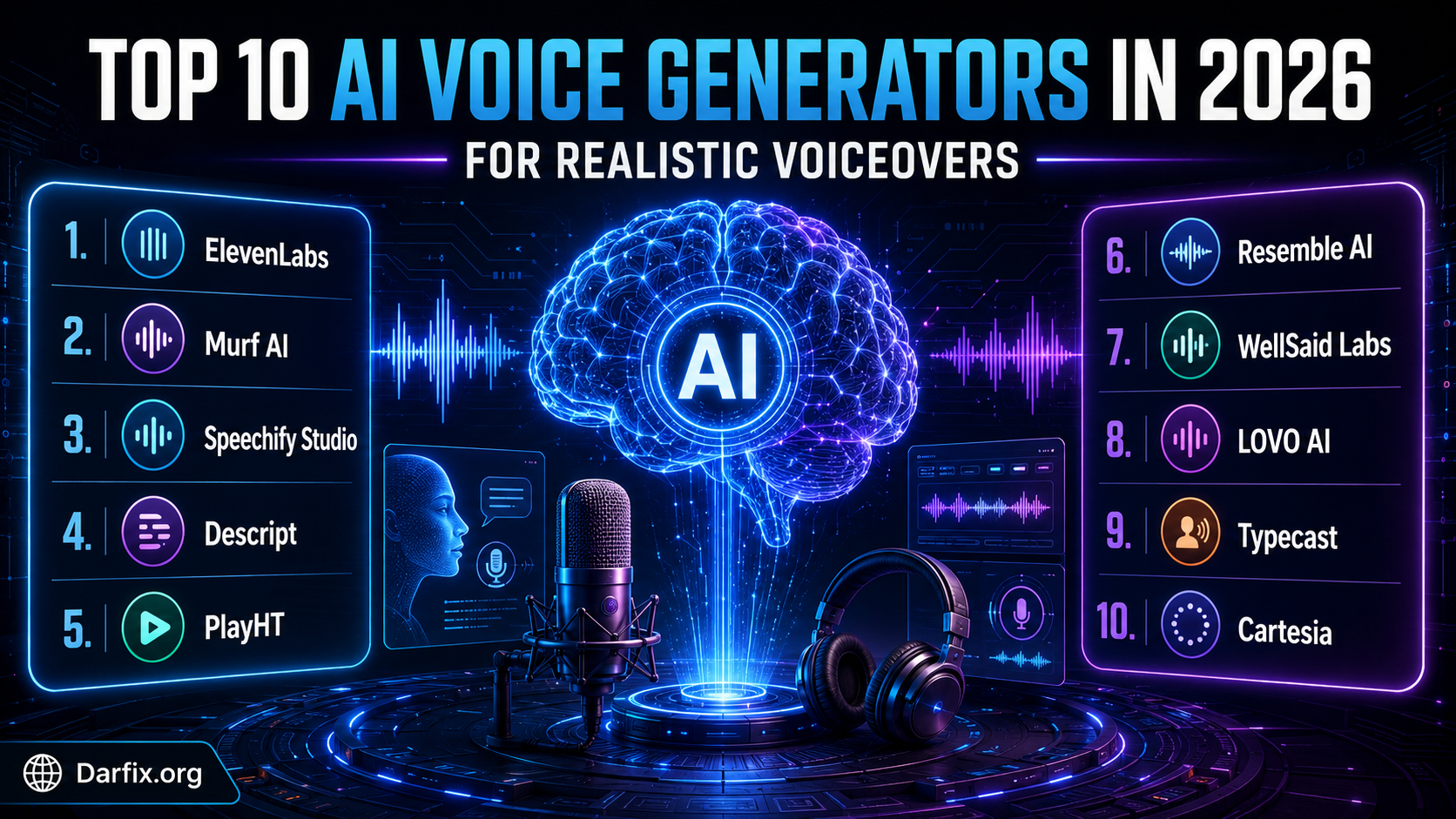
Top 10 AI Voice Generators in 2026 for Realistic Voiceovers
Artificial intelligence has transformed voice production. In 2026, creators can turn written scripts into natural-sounding narration, clone an authorized voice, translate speech into other languages and produce professional audio without using a traditional recording studio. AI voice generators are now used for YouTube videos, podcasts, audiobooks, advertisements, online courses, games, virtual assistants and business presentations. However, each platform has different strengths. Some focus on expressive narration, while others specialize in multilingual dubbing, voice cloning, audio editing or real-time voice applications. Here are ten of the most useful AI voice generators to know in 2026. 1. ElevenLabs ElevenLabs is one of the most widely recognized platforms for realistic AI speech. Users can convert text into expressive narration, create an original voice from a description, select voices from an extensive library or clone a voice when they have the necessary permission. The platform supports multilingual speech and provides tools for voiceovers, dubbing, audiobooks, games, podcasts and conversational voice agents. It is especially useful for creators who want natural pacing, emotion and clear pronunciation. 2. Murf AI Murf AI provides a complete voiceover studio for turning scripts into natural speech. Users can select different languages, accents and voices and then customize elements such as speed, pauses, emphasis and delivery. Murf also provides voice cloning, dubbing, voice changing and developer APIs. It is a practical choice for advertisements, presentations, training materials, product demonstrations and corporate videos. 3. Speechify Studio Speechify Studio combines AI voice generation with tools for creating complete audio and video projects. Users can produce voiceovers from written scripts, clone an authorized voice and add stock images, video clips or other media. The platform offers a large selection of voices and languages, making it useful for educational content, podcasts, advertisements, social-media videos and narrated articles. 4. Descript Descript combines AI voice generation with text-based audio and video editing. Users can generate narration from a script using a stock AI speaker or an authorized clone of their own voice. One of its most useful features is the ability to correct recorded speech by editing the transcript. A creator can replace a mistake, add a missing sentence or update a podcast without recording the entire section again. Descript is particularly useful for podcasters, YouTubers, interview editors and creators who want recording, transcription, voice generation and editing in one application. 5. PlayHT PlayHT, also known through its Play AI voice technology, provides text-to-speech generation, streaming speech and voice cloning for creators and developers. It supports multi-speaker content and can be used for narration, conversational assistants, games, applications and interactive experiences. Developers can also connect its voice technology to their own products through an API. PlayHT is a strong option for users who need both a visual voice-generation platform and technical integration tools. 6. Resemble AI Resemble AI focuses on voice creation, cloning, real-time speech and voice security. Businesses and developers can create synthetic voices, generate speech through an API and manage voice assets for applications or interactive agents. The platform also develops tools for detecting synthetic speech and protecting voice identities. This makes it suitable for games, customer-service systems, media production and companies that need stronger control over how generated voices are used. 7. WellSaid Labs WellSaid Labs specializes in professional voiceovers for businesses, training teams and media production. Its voice library was developed in collaboration with professional voice actors and includes many combinations of voices and delivery styles. Users can create narration for learning materials, product videos, advertisements and corporate communication. Developers can also use its text-to-speech API, while advanced controls allow adjustments to tempo, pauses, loudness, pitch and pronunciation. 8. LOVO AI LOVO provides an AI voice generator designed for narration, advertising, entertainment and digital content. Users can convert scripts into realistic speech, select different voices and create voiceovers for videos, podcasts, presentations and educational projects. The platform is useful for creators who want voice generation and multimedia production in a relatively accessible workspace. It also provides voice-cloning and expressive speech features for supported workflows. 9. Typecast Typecast focuses on expressive AI performances rather than basic robotic text-to-speech. Users can select virtual voice actors, enter a script and control the emotional style or delivery of the generated narration. It can be used for animated characters, audiobooks, advertisements, short films, social-media videos and storytelling. Typecast also provides video-editing and API options for creators and developers. 10. Cartesia Cartesia develops low-latency speech models primarily for real-time applications and conversational voice agents. Its tools include text-to-speech, voice conversion, dubbing, speech recognition and developer APIs. The platform is particularly relevant for customer-support agents, interactive applications, games and services where generated speech must begin quickly and respond naturally during a conversation. Which AI Voice Generator Should You Choose? ElevenLabs is a strong general choice for realistic narration, multilingual projects and expressive speech. Murf AI, Speechify Studio and WellSaid Labs are useful for professional videos, presentations, training and business content. Descript is particularly suitable for podcasts and videos because voice generation is integrated with transcription and text-based editing. PlayHT, Resemble AI and Cartesia provide useful APIs for developers building voice-enabled applications. LOVO and Typecast are practical choices for storytelling, characters, advertisements and entertainment content. Creators can also combine several tools. A script could be prepared with an AI writing assistant, narrated with ElevenLabs or Murf, corrected in Descript and added to a complete video project using a video-editing platform. Responsible Voice Cloning Voice cloning should only be performed with the clear permission of the person whose voice is being reproduced. Creators should never use synthetic speech to impersonate another person, deceive an audience or publish false statements in someone else’s voice. Before using generated audio commercially, users should review the platform’s current licensing conditions. Commercial rights, voice-cloning permissions and distribution rules may vary according to the service and subscription plan. AI voice generators can reduce recording time and make high-quality narration more accessible. However, human review remains necessary to correct pronunciation, improve emotional delivery and ensure that the final audio is accurate, ethical and appropriate for its audience.
Technology4d ago
Share:
Top 10 AI Game Development Tools in 2026 for Building Games Faster
Artificial intelligence is transforming almost every stage of game development. In 2026, developers can use AI to turn written ideas into playable prototypes, generate 2D and 3D assets, design characters, create intelligent NPCs, build game mechanics and test projects more efficiently. However, there is an important difference between an AI game generator and an AI-assisted development tool. Some platforms can create a simple playable game from a prompt, while others specialize in a specific part of production, such as concept design, programming, 3D modeling, artwork or character interaction. AI can significantly accelerate game development, but creating a polished commercial game still requires human direction, testing, balancing, storytelling and technical optimization. Here are ten of the most useful AI game development tools to know in 2026. 1. Rosebud AI Rosebud AI is one of the most accessible platforms for creating playable games from written descriptions. Users can describe a game idea, and the platform generates the code, mechanics and visual elements needed to produce a browser-based prototype. It can be used for creating platformers, role-playing games, puzzle games and other 2D or 3D experiences without traditional programming. Users can test the generated game immediately, request changes through conversation and publish the result online. Rosebud is especially useful for beginners, students, game jams and creators who want to test an idea before investing time in a larger production. 2. GDevelop AI GDevelop is an open-source, no-code game engine for creating and publishing 2D and 3D games. Its integrated AI creation agent understands the current game project and can help developers brainstorm ideas, build mechanics and work with objects, variables, behaviors and events. Unlike a general chatbot, GDevelop AI is designed specifically for the GDevelop engine. Users can describe the feature they want, and the assistant can help implement it directly inside the project. Games created with GDevelop can be published on the web, mobile platforms, desktop systems and stores such as Steam. It is a strong option for beginners who want more control than a basic prompt-to-game generator provides. 3. Unity AI Unity AI brings artificial intelligence directly into the Unity Editor. Its assistant can understand the context of a Unity project, inspect scenes and GameObjects, recommend solutions and help automate development tasks. Developers can use Unity AI to generate or modify project elements, troubleshoot problems, create scenes and accelerate repetitive workflows. Unity also provides an AI Gateway and an official MCP server for connecting external AI tools to the engine. Unity AI is most suitable for developers who want to use artificial intelligence inside a professional game engine while maintaining full control over the structure and final build of their project. 4. Ludo.ai Ludo.ai is an AI-powered research, planning and creative platform designed specifically for game development. It can help teams generate game concepts, mechanics, characters, stories, visual assets, sound effects and structured game design documents. The Game Ideator can create new concepts from keywords, themes or existing titles. Its project tools help developers organize gameplay systems, characters, narrative ideas and production requirements in one workspace. Ludo also provides AI-generated sprites, UI elements, textures, video, audio and other game assets. It is particularly useful during the early design and pre-production stages of a project. 5. Scenario Scenario is a creative AI platform designed for producing consistent game-ready artwork and visual assets. Studios can train custom models using their own art direction and generate characters, environments, items, icons and marketing visuals that follow a consistent style. The platform is useful when a project needs many variations of similar assets without losing visual consistency. Developers can generate, edit and reskin buildings, props, characters and other elements while preserving the required perspective and structure. Scenario is particularly suitable for professional game studios, mobile game developers, LiveOps teams and projects that require large quantities of coordinated visual content. 6. Meshy Meshy is an AI-powered 3D asset creation platform that can convert written prompts or reference images into textured 3D models. It includes tools for text-to-3D, image-to-3D, PBR texturing, remeshing, rigging and animation. Generated models can be exported in formats suitable for Unity, Unreal Engine, Roblox, Godot and web-based projects. This makes Meshy useful for creating characters, weapons, furniture, environmental objects and prototype assets. Meshy can significantly reduce the time required to create basic 3D content, although developers should still inspect topology, polygon counts, textures and animation quality before using generated assets in a final game. 7. Sloyd Sloyd specializes in generating optimized, game-ready 3D assets from text, images and customizable templates. It provides greater control over geometry and can generate objects with clean UV maps, level-of-detail options and performance-friendly structures. Developers can create props, buildings, weapons, furniture and stylized objects without manually modeling every item from the beginning. Sloyd also provides AI rigging, animation tools and plugins for engines and applications such as Unity, Unreal Engine, Godot and Blender. It is a practical option for indie developers who need large numbers of consistent 3D objects while maintaining control over technical properties. 8. Layer AI Layer AI is a creative production platform built primarily for game studios. It brings image, video, 3D and audio generation models into one workspace and allows teams to build reusable production workflows. Studios can train custom AI styles based on their own artwork and generate new characters, environments, items, UI components and marketing materials that follow the existing visual identity of a game. Layer also provides collaboration, editing and automation tools for producing assets at scale. It is particularly useful for mobile games, LiveOps content, advertising creatives and projects that need frequent visual updates. 9. Inworld AI Inworld AI provides real-time voice and interactive AI technology for games and virtual characters. Its tools can be used to build characters that understand speech, respond with generated dialogue and communicate using expressive synthetic voices. The Inworld Unreal AI Runtime includes building blocks such as speech-to-text, text-to-speech and language models. Developers can connect these components through visual pipelines and use templates for conversational NPCs and other interactive systems. Inworld is suitable for role-playing games, simulations, educational experiences and projects where characters need to respond dynamically instead of relying entirely on prewritten dialogue. 10. Convai Convai is a platform for creating intelligent NPCs with conversation, memory, environmental awareness and the ability to perform actions inside a game world. Developers can give a character a background, personality, knowledge and objectives. The NPC can then listen to players, respond naturally and interact with objects or execute actions within a scene. Convai provides integrations for major 3D engines and is especially useful for open-world games, role-playing experiences, virtual training and interactive simulations where believable character behavior is important. Which AI Game Development Tool Should You Choose? The right tool depends on the stage and type of project. Rosebud AI is suitable for quickly generating playable browser prototypes. GDevelop AI is a better choice for beginners who want to build and publish a more structured no-code game. Unity AI is designed for professional engine workflows, while Ludo.ai helps with game research, planning and pre-production. Scenario and Layer AI are strong options for producing consistent 2D art and visual content. Meshy and Sloyd focus on generating 3D models and game-ready objects. Inworld AI and Convai are designed for intelligent characters, voice interaction and dynamic NPC behavior. Developers can also combine several platforms in one production workflow. A team could plan a concept with Ludo.ai, create an initial prototype with GDevelop or Unity, generate character artwork with Scenario, build 3D assets with Meshy or Sloyd and add interactive NPCs using Inworld or Convai. Can AI Create a Complete Game? AI can already create simple playable prototypes, generate code and produce many of the assets required for a game. However, a commercially successful project still needs human developers, artists and designers. Generated mechanics may contain bugs, 3D assets may need optimization and AI-written stories can become repetitive or inconsistent. Gameplay must also be tested for difficulty, balance, performance and player enjoyment. AI should therefore be viewed as a development partner rather than a complete replacement for a game studio. Important Legal and Technical Considerations Before publishing a game containing AI-generated assets, developers should review the commercial-use and ownership terms of every platform they use. Uploaded reference images, character designs, voices and training materials should belong to the creator or be properly licensed. Developers should also avoid generating direct copies of copyrighted game characters, logos or distinctive visual styles. Every generated asset should be reviewed for technical quality. Models may require retopology, textures may need compression and generated code should be checked for security, performance and compatibility. Artificial intelligence can make game development faster and more accessible, but the strongest games will still depend on original ideas, careful design and human creativity.
Technology4d ago
Share:
Top 10 AI Music Generators in 2026 for Creating Original Songs
Artificial intelligence has changed the way music is created. In 2026, musicians, video creators, game developers and beginners can generate original songs, instrumentals, soundtracks, beats and vocals from a simple written description. Some AI music generators can produce a complete song with lyrics and vocals, while others focus on instrumental background music, cinematic scores, loops or customizable audio for commercial content. The following list presents ten of the most useful AI music generators in 2026. The order is based on their general usefulness, creative features and suitability for different types of users rather than a universal scientific ranking. 1. Suno Suno is one of the most accessible platforms for generating complete songs with artificial intelligence. Users can describe the genre, subject, mood and musical style they want, and the platform can create a finished track containing vocals, lyrics and instrumentation. Creators can also generate beats, remix tracks and develop new versions of previously created songs. Suno is suitable for beginners who want quick results as well as musicians who need inspiration for melodies, arrangements or song concepts. Its simple workflow makes it possible to turn a short idea into a complete musical production without needing advanced knowledge of recording, composition or audio engineering. 2. Udio Udio is an AI-powered music creation platform that allows users to generate original tracks within seconds. Creators can enter a written description, provide lyrics and experiment with different musical genres, vocal styles and arrangements. The platform is useful for producing songs, extending musical sections and exploring alternative versions of the same concept. Its creative workflow is suitable for songwriters, producers and users who want more control over the direction of their generated music. Udio also includes sharing features that allow creators to publish and discover music created by other members of the platform. 3. ElevenLabs Music ElevenLabs Music can generate complete songs, instrumentals, melodies, rap beats and vocals from written instructions. Users can describe the desired genre, emotional atmosphere, instrumentation and lyrical direction. The platform is particularly useful for creators who already use ElevenLabs for voiceovers, dubbing or sound effects and want to produce several types of audio within the same ecosystem. ElevenLabs introduced Music v2 in 2026 with improvements to vocals, instrumentation and musical arrangements across multiple genres. 4. Stable Audio Stable Audio is a generative platform developed by Stability AI for creating music, sound effects and soundscapes. Users can describe the audio they want using text and generate an original result based on the selected mood, instruments and musical characteristics. The platform also supports audio-to-audio workflows. Creators can upload an audio reference and use it to guide the direction of a new piece of music or sound design. Stable Audio is suitable for producers, filmmakers, game developers and content creators who need instrumentals, loops, environmental sounds or experimental audio. 5. AIVA AIVA is an AI music composition assistant designed for creating original musical pieces in more than 250 styles. It is especially popular for cinematic scores, orchestral music, emotional soundtracks and instrumental compositions. Users can select a style, provide musical influences and generate compositions that can be downloaded in common audio formats. Depending on the selected plan, creators may also be able to access MIDI files and continue editing their compositions inside digital audio workstations. AIVA is particularly useful for filmmakers, composers, game developers and creators who need structured instrumental music rather than a vocal pop song. 6. SOUNDRAW SOUNDRAW is an AI music generator built to make music creation more accessible to creators and musicians. It can generate background scores, podcast introductions, beats and instrumental tracks based on selected genres, moods and durations. One of SOUNDRAW’s most practical features is the ability to customize the structure of a generated track. Users can adjust its length, energy and individual sections instead of accepting only one fixed result. It is a strong option for YouTubers, podcasters, advertisers, rappers and creators who need customizable background music for their projects. 7. Beatoven.ai Beatoven.ai creates music for videos, podcasts, films, games and other digital content. Users can describe a scene, emotion or creative idea through text and multimodal prompts, and the system generates a soundtrack that matches the requested atmosphere. The platform’s Maestro model was trained using millions of ethically sourced music and sound-effect tracks. Beatoven.ai is designed primarily for creators who need instrumental background music that supports a visual story without distracting from narration or dialogue. It can be useful for documentary scenes, advertisements, travel videos, educational content and cinematic projects. 8. Loudly Loudly combines AI music generation with editing and production tools. Users can create tracks by describing their desired sound or selecting parameters such as genre, tempo, energy, duration, instruments and song structure. Generated music can be exported in formats such as MP3 and WAV. Loudly also provides access to stems, samples, effects, mastering and remixing features, giving producers more control over the finished track. The platform is suitable for social-media creators, musicians, marketing teams, game studios and developers who need customizable music or API-based audio generation. 9. Mubert Mubert focuses on generating music for videos, live streams, applications, podcasts and digital experiences. Users can request music based on a mood, genre, theme or intended use. The platform can generate tracks and loops for many different situations, including advertisements, product launches, ambient experiences, short-form videos and game content. Mubert also offers API solutions that allow businesses and developers to integrate generated music into their own services. It is particularly useful for creators who need continuous background music, short loops or soundtracks adapted to digital content. 10. Soundverse Soundverse is an AI production studio for creating songs, instrumental music, lyrics, voices and other audio content. Its song generator can turn an idea or a set of lyrics into a complete production containing vocals, instruments and an arrangement. The platform also provides text-to-music tools for generating instrumentals with drums, bass, chords and melodies. This makes Soundverse useful for both creators who want complete vocal songs and producers who only need instrumental material. Its AI producer workflow is designed to help users develop, arrange and refine their musical ideas without requiring extensive knowledge of music theory or professional production software. Which AI Music Generator Should You Choose? Suno and Udio are strong options for quickly producing complete songs with vocals and lyrics. ElevenLabs Music is useful for creators who want music, speech, voiceovers and sound effects inside one audio platform. Stable Audio is suitable for experimental music, sound effects and audio-guided generation, while AIVA is a better choice for cinematic and orchestral compositions. SOUNDRAW, Beatoven.ai, Loudly and Mubert are practical options for generating background music for videos, podcasts, games, advertisements and social-media projects. Soundverse provides a broader production workflow for songs, instrumentals, lyrics and voices. A professional creator may combine several platforms. For example, a songwriter could prepare lyrics with an AI assistant, generate the first version in Suno or Udio, create additional instrumental material with Stable Audio, produce background music with Beatoven.ai and complete the final editing inside a digital audio workstation. Important Licensing Considerations AI-generated music should always be reviewed before it is published or used commercially. The ownership, monetization and distribution rights may depend on the platform, subscription plan and type of material used in the generation process. Creators should read the current license terms before uploading generated music to YouTube, Spotify, Apple Music, games, advertisements or commercial projects. Users should also avoid requesting direct copies of copyrighted songs or imitating the recognizable voice of a real artist without permission. Artificial intelligence can accelerate music production, but human creativity, editing and responsible use remain essential for creating original and trustworthy work.
Technology4d ago
Share:
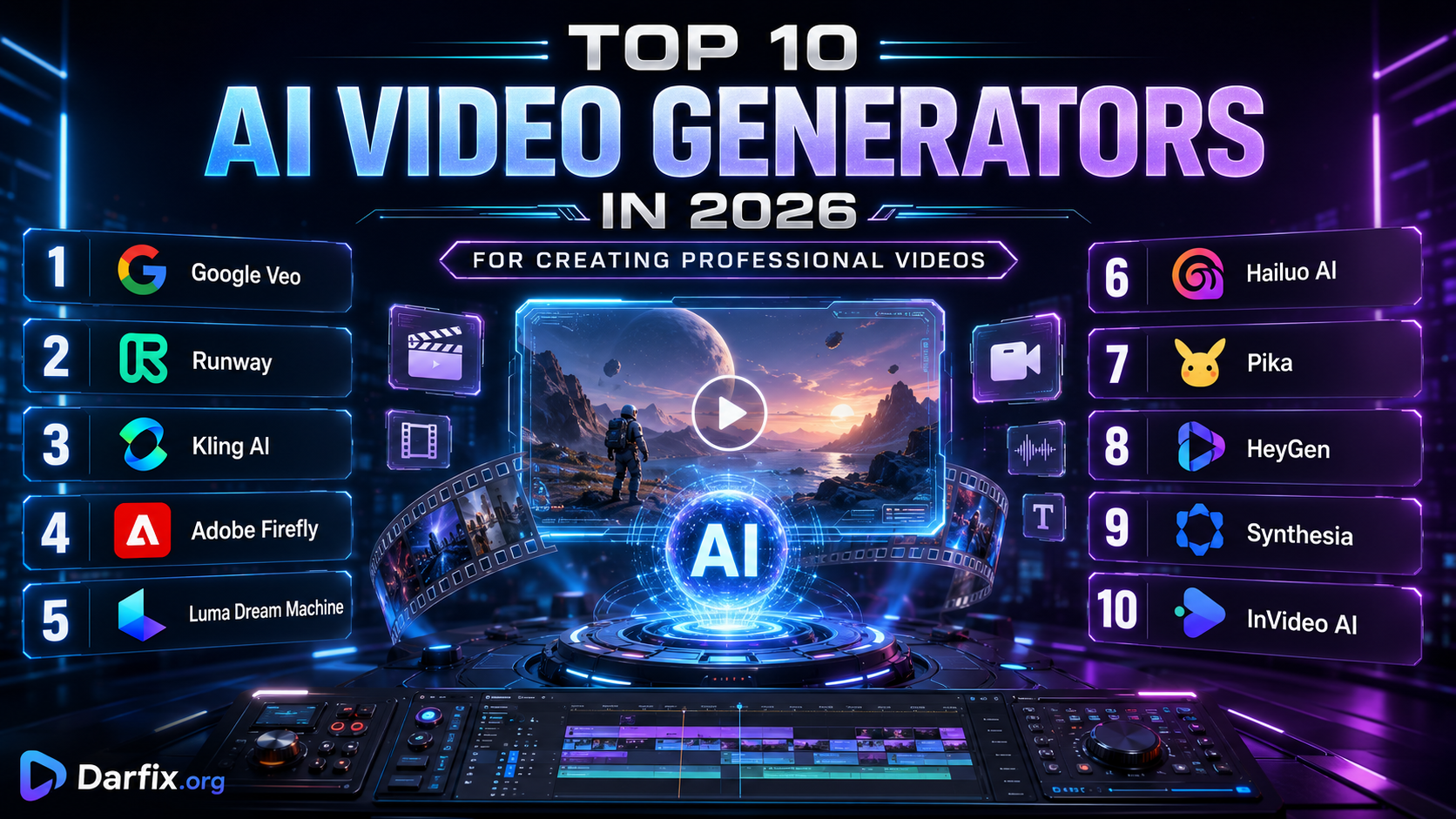
Top 10 AI Video Generators in 2026 for Creating Professional Videos
Artificial intelligence has transformed video production. In 2026, creators can generate cinematic clips, animate still images, build advertisements, create virtual presenters and produce complete social-media videos from simple written instructions. Some AI video generators focus on realistic cinematic scenes, while others specialize in talking avatars, product demonstrations, training videos or complete automated production. Choosing the right platform depends on the type of content you want to create. Here are ten of the most useful AI video generators to know in 2026. 1. Google Veo Google Veo is one of the most advanced generative video systems available. It can create videos from written prompts or reference images and can generate synchronized audio alongside the visuals. Veo is especially suitable for realistic scenes, cinematic camera movement, environmental sound, dialogue and short narrative sequences. It is a strong option for filmmakers, advertisers and creators who want professional-looking footage without traditional filming equipment. 2. Runway Runway combines AI video generation with professional creative and editing tools. Users can create videos from text, animate an image, transform existing footage or extend a video beyond its original duration. The platform is particularly useful for concept films, advertisements, music videos, visual effects and experimental storytelling. Runway also focuses on maintaining consistent characters, objects and environments across generated scenes. 3. Kling AI Kling AI is a creative platform for generating videos, images, audio, avatars and visual effects. It supports both text-to-video and image-to-video workflows, allowing users to describe a scene or animate an existing picture. Kling is popular for realistic motion, cinematic compositions, character animation and social-media content. It can also use reference material to improve the consistency of subjects across different generated shots. 4. Adobe Firefly Video Adobe Firefly provides AI tools for generating and editing video inside a broader professional creative environment. Users can create clips from written prompts or reference images and then continue editing the results with Adobe applications. Firefly is especially useful for advertisements, background footage, motion-design concepts, product visuals and professional post-production. Its integration with Adobe Creative Cloud makes it a practical choice for editors, designers and marketing teams. 5. Luma Dream Machine Luma Dream Machine generates cinematic videos from text descriptions and still images. Its Ray video technology is designed to create controlled movement, visual continuity and production-quality scenes. Creators can use Luma for music videos, promotional clips, short films, environmental shots and animated concept art. It is particularly useful when a static image needs to be transformed into a dynamic cinematic sequence. 6. Hailuo AI Hailuo AI, developed by MiniMax, provides text-to-video and image-to-video generation for creators. It can produce short visual sequences with detailed motion, characters, environments and cinematic camera behavior. The platform is suitable for storytelling, advertising concepts, fantasy scenes, social-media videos and experimental filmmaking. Its Media Agent also aims to simplify the production process by turning basic instructions into more complete creative outputs. 7. Pika Pika is designed for fast, creative and social-first AI video generation. It can animate images, transform subjects and create short videos based on prompts, photographs, sounds and popular visual trends. Pika is especially useful for viral clips, memes, transformations, music-based animations and short social-media content. Its accessible interface makes it suitable for beginners who want visually engaging results without complex editing software. 8. HeyGen HeyGen specializes in videos featuring realistic AI presenters and digital avatars. Users can enter a script, select an avatar and voice and generate a polished presentation without recording a real person. The platform is useful for product demonstrations, marketing campaigns, educational videos, training, onboarding and multilingual communication. It also provides voice cloning, translation and lip-sync features for producing content in different languages. 9. Synthesia Synthesia is an AI video platform focused on professional and business communication. Users can begin with a prompt, script, document or web page and turn the material into a structured video with scenes, narration and digital presenters. It is particularly suitable for employee training, tutorials, company announcements, educational courses and localized business content. Synthesia offers AI avatars and voiceovers in many languages, helping organizations create multiple versions of the same video. 10. InVideo AI InVideo AI helps users create complete videos from simple written instructions. It can prepare a script, select or generate visuals, add narration, subtitles, background music and transitions and organize everything into a finished video. This makes it useful for YouTube videos, advertisements, explainers, promotional content and social-media posts. InVideo is a strong choice for creators who need a complete production workflow rather than only a short generated clip. Which AI Video Generator Should You Choose? Google Veo, Runway, Kling AI, Adobe Firefly and Luma Dream Machine are strong choices for cinematic and creative video generation. Pika is suitable for fast social-media content, while Hailuo AI is useful for imaginative visual sequences and automated creative workflows. HeyGen and Synthesia are better choices for talking presenters, training materials and multilingual business videos. InVideo AI is designed for users who want an entire video—including the script, narration, footage, subtitles and music—created within one platform. Professional creators can also combine multiple tools. A scene could be generated with Veo or Kling, edited with Runway or Adobe software, narrated with an AI voice and assembled into a complete publication using InVideo. AI video generation can reduce production time and make visual storytelling more accessible, but every result should be reviewed before publication. Creators should check factual accuracy, visual consistency, commercial-use conditions and the rights associated with uploaded images, voices and reference materials. Artificial intelligence is not replacing filmmakers or video editors. It is becoming a powerful production partner that allows creators to test ideas, visualize stories and create professional content faster.
Technology4d ago
Share:
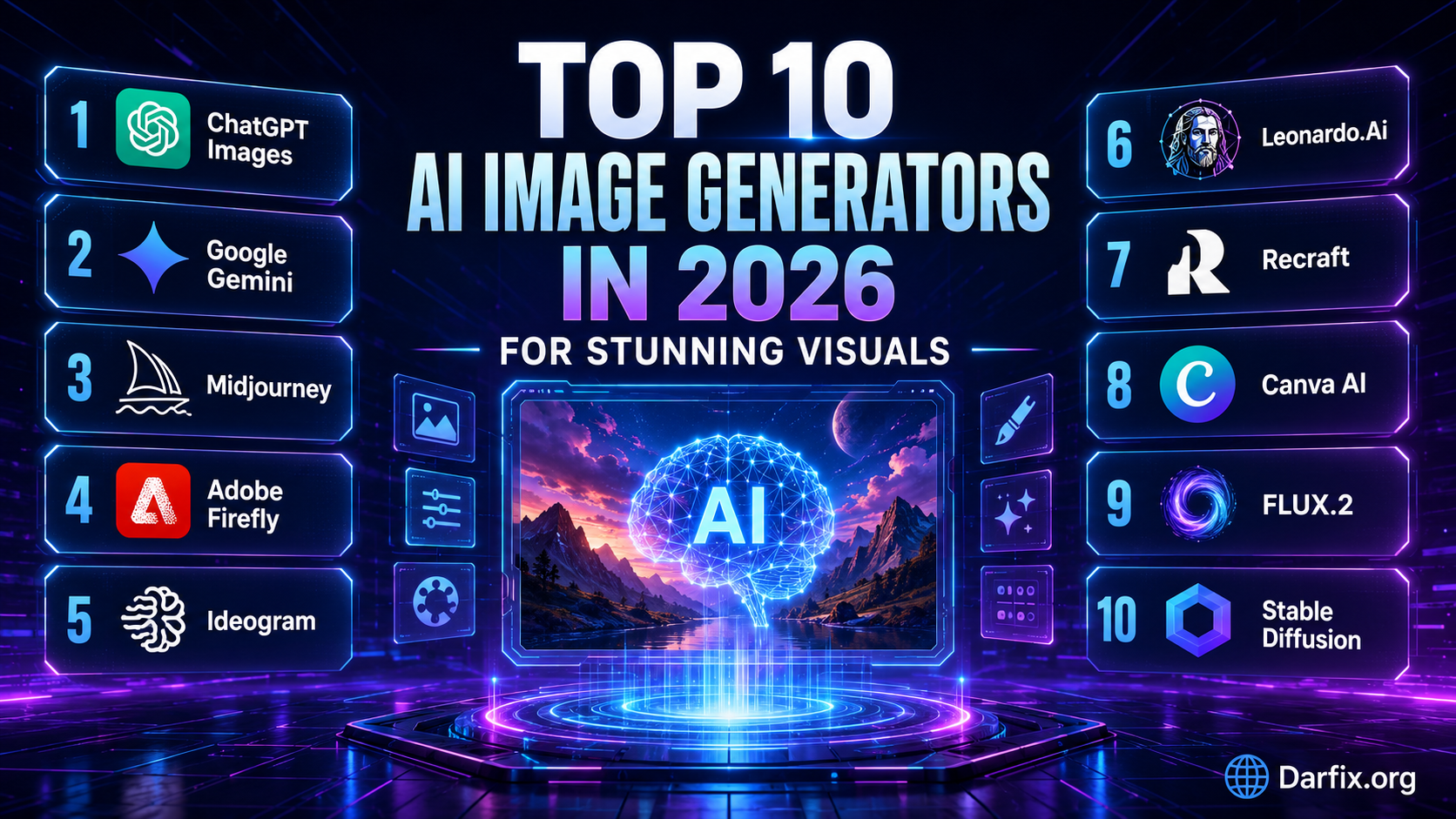
Top 10 AI Image Generators in 2026 for Stunning Visuals
Artificial intelligence has completely changed the way images are created. In 2026, users no longer need advanced photography or graphic design skills to produce professional illustrations, realistic photos, advertising visuals, posters, thumbnails and concept art. Modern AI image generators can turn a short written description into a detailed visual within seconds. Many of them can also edit existing photos, replace objects, expand backgrounds, improve image quality and maintain consistent characters across multiple scenes. However, every platform has different strengths. Some tools are designed for realistic photography, while others are better for artistic images, typography, branding, vector graphics or professional editing. Here are ten of the most powerful AI image generators to know in 2026. 1. ChatGPT Images ChatGPT Images provides a conversational way to create and edit visuals. Users can describe an idea in natural language, generate an image and then request specific changes without writing an entirely new prompt. The platform is particularly useful for creating website covers, social media graphics, advertisements, infographics, illustrations and images containing readable text. Users can also upload existing pictures and ask ChatGPT to remove objects, change backgrounds, adjust colors or transform the visual style. ChatGPT is a strong choice for users who want both image generation and intelligent editing in one simple workspace. 2. Google Gemini and Nano Banana Pro Google Gemini offers advanced image generation and editing through its visual AI models, including Nano Banana Pro. It can create realistic scenes, illustrations, diagrams, product images and designs from detailed instructions. One of its most useful capabilities is conversational image editing. Users can upload an image and request changes while preserving important elements such as the subject, composition or visual identity. Gemini is particularly suitable for users who already work with Google products and need an AI assistant that can understand text, images and other forms of information together. 3. Midjourney Midjourney remains one of the most popular platforms for producing cinematic, artistic and visually impressive images. It is especially strong at lighting, atmosphere, composition, fantasy environments, character concepts and editorial artwork. Users can control the aspect ratio, visual style, level of detail and creative variation of each result. Midjourney also provides personalization features that help the system understand the visual preferences of each creator. It is an excellent option for digital artists, game designers, filmmakers, advertising teams and creators who prioritize visual beauty. 4. Adobe Firefly Adobe Firefly is an AI creative platform for generating and editing images, graphics, video and audio. Its close integration with applications such as Photoshop and Illustrator makes it particularly valuable for professional designers and creative teams. Firefly includes tools for text-to-image generation, generative fill, background replacement, object removal, image expansion and vector creation. Users can generate new elements and insert them directly into an existing design. It is a practical choice for commercial design workflows, marketing campaigns, product visuals and professional photo editing. 5. Ideogram Ideogram is widely recognized for creating images that contain accurate and readable text. This makes it especially useful for posters, advertisements, logos, book covers, social media graphics and YouTube thumbnails. The platform can combine typography with realistic photography, illustrations or graphic design. It also offers tools for editing images, removing backgrounds, reframing compositions and generating transparent elements. Ideogram is one of the strongest choices when written words must appear clearly inside an AI-generated image. 6. Leonardo.Ai Leonardo.Ai is a complete visual creation platform for generating images, artwork, game assets, product designs and marketing content. It provides multiple AI models and detailed controls for different creative styles. Users can generate realistic photos, fantasy characters, environments, illustrations and concept art. Existing images can also be edited, expanded, enhanced or transformed into short animations. Leonardo.Ai is particularly useful for game developers, designers, content creators and businesses that need many visual assets with a consistent style. 7. Recraft Recraft is designed for professional graphics, branding and visual design. Unlike many generators that focus mainly on photographs, Recraft can produce vectors, icons, logos, illustrations, mockups and advertising materials. Its tools allow creators to generate coordinated visual assets, maintain consistent brand colors and prepare scalable graphics for websites, applications and printed products. Recraft is a strong option for graphic designers, branding specialists, online stores and interface designers. 8. Canva AI Canva AI brings image generation directly into Canva’s popular design environment. Users can create a visual and immediately place it inside a presentation, poster, advertisement, website banner or social media post. Canva provides tools such as Magic Media, Dream Lab, Magic Edit and Magic Expand. These features can generate images, modify parts of a photograph, extend backgrounds and help users create complete designs from a simple idea. It is one of the easiest choices for beginners, social media managers, students, small businesses and people who want ready-to-publish content. 9. FLUX.2 FLUX.2 is an advanced image-generation and editing model developed by Black Forest Labs. It is designed to produce detailed images with strong prompt accuracy, realistic textures and professional visual quality. The model supports text-to-image creation, image editing and workflows that use multiple reference images. This makes it useful for product visualization, advertising, character consistency and complex creative projects. FLUX is also popular among developers because different versions can be integrated into applications or used in custom image-generation workflows. 10. Stable Image and Stable Diffusion Stability AI provides several image-generation services through the Stable Image and Stable Diffusion ecosystem. These models can generate images from text, edit specific areas, remove objects, expand backgrounds and enhance low-resolution pictures. Stable Diffusion is especially important for advanced users and developers who want greater technical control over their image-generation workflow. Depending on the selected model and license, it may also be used through APIs or installed in custom environments. It is a strong choice for developers, researchers, studios and creators who want flexible image-generation tools. Which AI Image Generator Should You Choose? The best platform depends on the type of image you want to create. ChatGPT Images and Google Gemini are excellent for conversational creation and editing. Midjourney is ideal for cinematic and artistic visuals, while Adobe Firefly is designed for professional creative workflows. Ideogram is a strong choice for images containing text. Leonardo.Ai is suitable for game assets and concept art, Recraft specializes in vectors and branding, and Canva AI makes it easy to produce complete social media and marketing designs. FLUX.2 and Stable Diffusion provide advanced options for developers and users who need more control over their image-generation systems. Professional creators often combine several tools. For example, they may generate a cinematic background with Midjourney, create readable typography with Ideogram, edit the final composition in Adobe Firefly and assemble the finished advertisement in Canva. Before publishing AI-generated images, users should review the output carefully, check the platform’s commercial-use terms and avoid using protected brands, copyrighted characters or real people in misleading ways. AI image generators cannot replace human creativity, but they can help creators experiment faster, reduce production time and transform ideas into professional visuals more efficiently.
Technology4d ago
Share:
Top 10 AI Tools in 2026 You Should Know
Artificial intelligence has become an essential part of modern work, education, research and digital content creation. In 2026, AI tools can help users write articles, analyze documents, generate professional images, create videos, produce realistic voices, research information and automate repetitive tasks. However, every AI platform has a different purpose. Some tools work as general assistants, while others specialize in visual design, research, video production or voice generation. Here are ten of the most useful AI tools you should know in 2026. 1. ChatGPT ChatGPT is a versatile AI assistant that can help with writing, brainstorming, research, coding, document analysis, planning and problem-solving. It is suitable for students, content creators, developers, businesses and everyday users who need a flexible assistant for different tasks. 2. Google Gemini Google Gemini is a multimodal AI assistant developed for research, writing, planning and working with text, images and documents. It is particularly useful for users who already work with Google services and need an AI assistant integrated into their daily workflow. 3. Claude Claude is known for its clear writing style, strong reasoning abilities and capacity to work with long documents. It can help users summarize reports, improve articles, review ideas, analyze information and create structured professional content. 4. Microsoft Copilot Microsoft Copilot is designed to improve productivity across Microsoft applications and devices. It can assist with writing emails, preparing documents, creating presentations, analyzing information and completing everyday office tasks. 5. Perplexity AI Perplexity is an AI-powered research and search platform. It searches the web and presents organized answers with references to its information sources. This makes it useful for research, fact-checking, comparing products and quickly learning about unfamiliar topics. 6. Midjourney Midjourney is one of the most popular AI image-generation platforms. It can create detailed illustrations, cinematic scenes, advertising visuals, concept art and imaginative designs from written descriptions. 7. Canva AI Canva AI combines artificial intelligence with an easy-to-use design platform. Users can create social media posts, presentations, advertisements, documents, videos and branded graphics without needing advanced graphic design experience. 8. Adobe Firefly Adobe Firefly provides generative AI tools for creating and editing images, videos and graphic designs. Its integration with Adobe applications makes it especially useful for professional designers, photographers, marketers and creative teams. 9. Runway Runway focuses on AI-powered video generation and editing. It can transform text and images into video, extend existing footage, remove unwanted objects and help creators produce advertising, cinematic and social media content. 10. ElevenLabs ElevenLabs specializes in realistic AI-generated voices and speech. It can turn written text into natural narration for videos, podcasts, audiobooks, games and educational content. It also supports multiple languages and different voice styles. Which AI Tool Is Best? The best AI tool depends on the type of work you want to complete. ChatGPT, Gemini and Claude are suitable for general assistance, writing and analysis. Perplexity is useful for web research, while Midjourney, Canva AI and Adobe Firefly focus on visual content. Runway is designed for AI video production, ElevenLabs specializes in voice generation and Microsoft Copilot is a strong option for users working with Microsoft applications. Professional creators can achieve better results by combining several platforms. For example, they can research a topic with Perplexity, prepare the article with ChatGPT or Claude, design its cover with Midjourney or Firefly, create a video with Runway and generate narration with ElevenLabs. AI tools can save time and improve creativity, but generated content should always be reviewed before publication. Users must verify important information, protect private data and check the copyright and commercial-use conditions of each platform. Artificial intelligence is not replacing human creativity. Instead, it is becoming a powerful partner that helps people turn their ideas into high-quality content faster and more efficiently.
Technology4d ago
Share:
Apple Foldable iPhone: Everything We Know So Far
Apple Foldable iPhone is expected to be Apple's first foldable smartphone, combining an elegant foldable design with cutting-edge technology and Apple Intelligence. Although the device has not been officially released, it has already become one of the most anticipated smartphones in the world. Based on trusted industry reports and leaks, it is expected to feature a nearly crease-free OLED display, a durable hinge, flagship performance, advanced Al features, and an optimized iOS experience. Explore the latest rumors, expected specifications, possible release date, and everything we know so far about Apple's revolutionary foldable iPhone
Technology5d ago
Share: