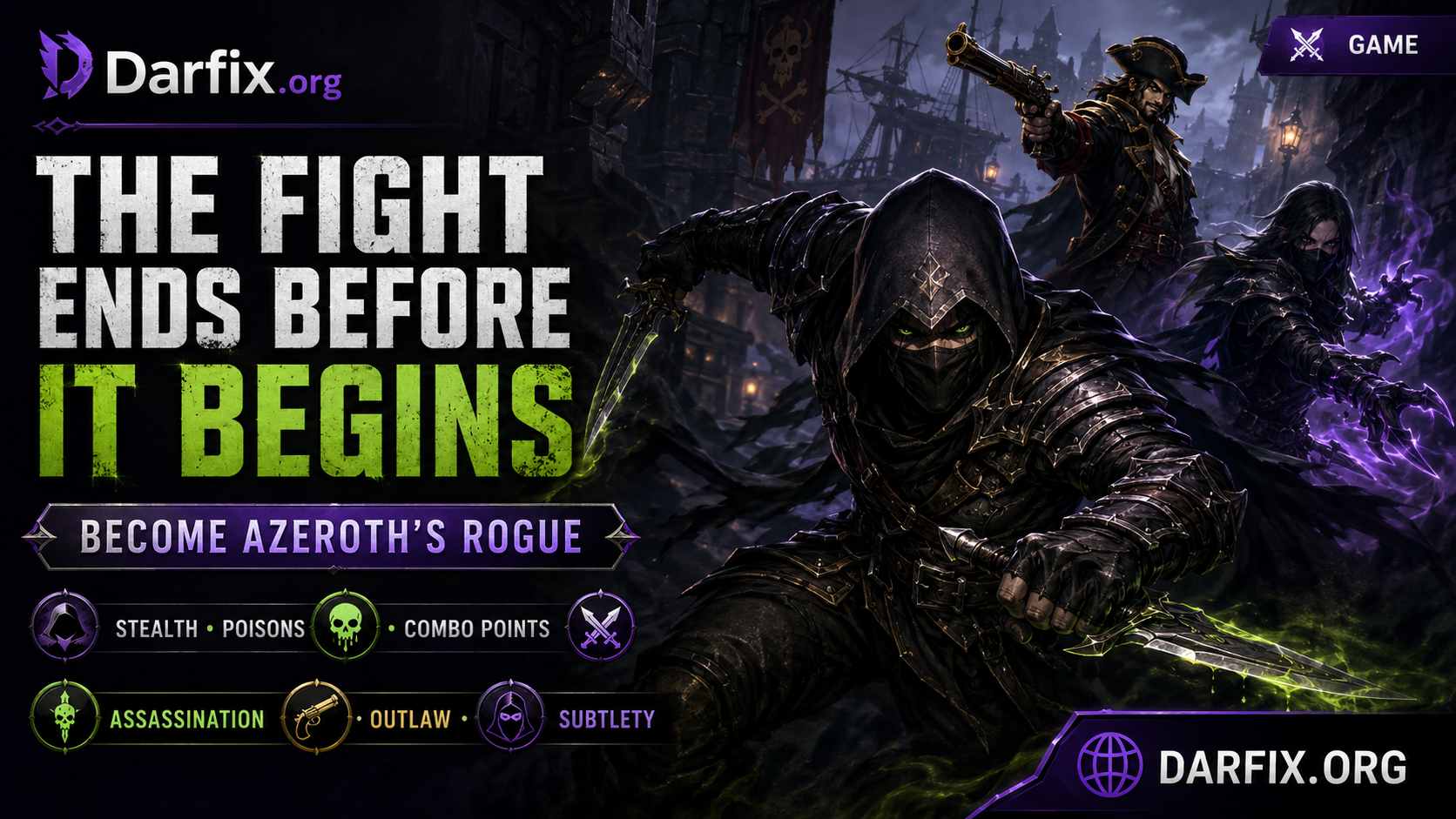
The Fight Ends Before It Begins: Become Azeroth’s Rogue
Gaming2 views2026-08-01
The Rogue is World of Warcraft’s master of stealth, poisons, deception and controlled melee combat. Rogues do not normally defeat enemies by standing in front of them and trading heavy attacks. They choose when a battle begins, disable dangerous targets and strike before the opponent has time to react.
Rogue is a pure Damage class. All three Specializations deal melee damage, but each creates a very different fantasy and combat rhythm.
Assassination uses poisons, bleeding effects and deadly dagger attacks.
Outlaw fights like a fast-moving duelist or pirate using blades, pistols and unpredictable combat advantages.
Subtlety enters and leaves the shadows repeatedly, combining precise dagger attacks with Shadow-enhanced burst damage.
Rogues wear Leather armor. They are less heavily protected than Warriors, Paladins and Death Knights, so survival depends heavily on movement, control abilities and using defensive tools at the correct moment.
The class can use daggers, fist weapons, one-handed axes, one-handed maces and one-handed swords. The preferred weapon depends on the selected Specialization.
Assassination and Subtlety are strongly associated with daggers. Outlaw commonly uses one-handed swords, axes, maces, fist weapons or a combination of suitable weapons.
Energy and Combo Points
Rogues use Energy as their main combat resource. Energy regenerates automatically and is spent on attacks, poisons and control abilities.
Most basic attacks generate Combo Points on the current target. These points are then spent on powerful Finishing Moves.
A Finishing Move becomes stronger when more Combo Points are consumed. This creates the central Rogue combat cycle:
Use Energy to perform generating attacks.
Build Combo Points.
Spend those points on a powerful finishing ability.
Allow Energy to recover while preparing the next sequence.
Spending resources without planning can leave the Rogue unable to interrupt, stun or finish an enemy at an important moment. Successful Rogue gameplay depends on balancing immediate aggression with resource preparation.
Stealth
Stealth is the defining Rogue ability. It allows the character to approach many enemies without being detected and begin combat with a specialized opening attack.
Stealth does not make the Rogue completely invisible under every condition. Nearby enemies, special detection abilities and direct damage can reveal the character.
The real advantage of Stealth is control. A Rogue can examine an area, avoid unnecessary enemies, select a priority target and decide how the engagement should begin.
Sap can temporarily remove certain enemies from combat before the first attack occurs. This can make a dangerous group easier to manage.
Distract can redirect an enemy’s attention and change the direction it is facing, creating opportunities to pass unseen or prepare an attack.
Vanish allows the Rogue to disappear during combat and regain access to abilities that normally require Stealth. It can be used offensively to begin another attack sequence or defensively to escape danger.
Assassination Rogue
Assassination is the poison and bleeding Specialization. It represents a patient killer who weakens an enemy over time before delivering the final strike.
Assassination normally fights with two daggers. Its attacks apply poisons, open wounds and create persistent effects that continue damaging the target after the initial strike.
Mutilate is one of the Specialization’s principal Combo Point generators. The Rogue attacks with both weapons and begins preparing stronger finishing abilities.
Envenom consumes Combo Points to deliver poison-based damage and strengthen the Rogue’s poison-focused pressure.
Rupture applies a bleeding effect whose duration increases according to the number of Combo Points spent. Maintaining this effect is an important part of Assassination combat.
Garrote can be used from Stealth to silence or damage a target while beginning another bleeding effect. This makes the opening moments of combat particularly important.
Assassination performs best when the Rogue can maintain poisons and bleeding effects long enough for their full value to develop. It is less focused on one instant attack and more focused on creating several connected sources of damage.
This Specialization is suitable for players who enjoy:
• Dual-wielding daggers
• Poisons and bleeding effects
• Damage that builds over time
• Carefully preparing an enemy for execution
• Strong single-target pressure
• A traditional assassin fantasy
Assassination can be approachable for beginners because its theme and core resource cycle are clear. However, players must learn to maintain several effects without refreshing them too early or allowing them to expire.
Enemies that die extremely quickly may not survive long enough for all poison and bleeding effects to provide their full value. Assassination feels more complete during longer encounters against elite enemies and bosses.
Outlaw Rogue
Outlaw transforms the Rogue into a daring duelist, pirate and close-range gunslinger. It is faster and more openly aggressive than the patient Assassination style.
Outlaw commonly fights with one-handed swords, axes, maces or fist weapons. It combines rapid weapon attacks with pistol shots, acrobatic movement and combat tricks.
Sinister Strike is one of its principal generating attacks. It builds Combo Points and can create opportunities for additional attacks.
Dispatch is a powerful Finishing Move that converts accumulated Combo Points into direct weapon damage.
Pistol Shot gives Outlaw a distinctive ranged element. Although the Specialization remains a melee fighter, it can fire a concealed pistol during its attack sequence.
Blade Flurry allows the Rogue to damage additional nearby enemies while attacking a primary target. It is one of Outlaw’s most recognizable tools when fighting groups.
Roll the Bones provides temporary combat advantages that can change the rhythm of a fight. The player must adapt to the benefits currently available rather than following exactly the same sequence in every situation.
Grappling Hook gives Outlaw excellent movement. The Rogue can rapidly cross terrain, enter combat or escape dangerous ground effects.
This Specialization is suitable for players who enjoy:
• A pirate or swashbuckler fantasy
• Fast melee combat
• Swords, axes, maces and pistols
• Fighting several nearby enemies
• High mobility
• Adapting to changing combat advantages
Outlaw is energetic and visually distinctive, but its speed can initially feel demanding. Energy, Combo Points, temporary effects and frequent attacks must all be managed while the player continues moving.
It is a strong choice for players who find daggers and poison-based gameplay too slow. Outlaw makes the Rogue feel less like a hidden assassin and more like a fearless combat opportunist.
Subtlety Rogue
Subtlety is the Specialization most deeply connected to Stealth and Shadow magic. It attacks from darkness, creates short periods of intense pressure and disappears before the enemy can respond effectively.
Subtlety normally uses daggers. Its combat revolves around selecting the correct moment to enter a powerful burst sequence.
Shadowstrike allows the Rogue to emerge from Stealth and attack an enemy with Shadow-enhanced speed.
Eviscerate consumes Combo Points to deliver powerful direct damage against a selected target.
Black Powder provides an area-damage Finishing Move when several enemies are grouped together.
Shadow Dance allows the Rogue to temporarily use Stealth-related abilities during active combat. This makes Stealth part of the entire encounter rather than only the opening attack.
Shadow Blades strengthens the Rogue’s attacks with supernatural power and supports periods of concentrated damage.
Subtlety rewards preparation. The Rogue attempts to build resources, activate important effects and then spend everything during a carefully timed attack window.
This Specialization is suitable for players who enjoy:
• Daggers and Shadow magic
• Repeated access to Stealth abilities
• Powerful short damage windows
• Precise resource preparation
• Rapidly attacking priority targets
• A supernatural shadow-assassin fantasy
Subtlety can be more difficult for a completely new player because poor timing may weaken an entire attack sequence. Using an important ability without enough Energy or Combo Points can waste the strongest part of the rotation.
Players who enjoy learning combinations and planning several actions in advance may find Subtlety especially rewarding.
Poisons
Poisons provide Rogues with additional damage and control. A Rogue can apply different poisons depending on the enemy and type of activity.
Some poisons focus on direct or persistent damage.
Other poisons reduce movement speed, weaken enemy actions or provide specialized utility.
Choosing the correct poison is part of preparing for combat. A poison useful against ordinary enemies may not be the best choice for a boss or Player-versus-Player encounter.
Poisons strengthen the class fantasy that Rogues win through preparation rather than physical strength alone.
Control and Utility
Rogues possess some of the strongest enemy-control tools in World of Warcraft.
Cheap Shot can stun an enemy when the Rogue attacks from Stealth.
Kidney Shot spends Combo Points to create a longer stun.
Blind temporarily removes a target from combat, although damage may break the effect.
Sap disables certain enemies before combat begins.
Kick interrupts enemy spellcasting and is one of the Rogue’s most important responsibilities in group content.
Crimson Vial restores part of the Rogue’s health and provides emergency recovery.
Evasion increases the Rogue’s ability to avoid physical attacks.
Cloak of Shadows protects against many magical effects and can remove certain harmful conditions.
Feint reduces incoming area damage and rewards players who anticipate dangerous enemy abilities.
Vanish can escape combat, avoid danger or begin another Stealth attack sequence.
Shroud of Concealment hides nearby group members for a limited time. Organized groups can use it to bypass selected enemies inside a dungeon.
Rogues can also pick locks and use Pick Pocket against suitable enemies. These abilities preserve the class’s identity outside direct combat.
Rogue Strengths
Rogues have exceptional control over how fights begin. Stealth, Sap and Distract allow them to avoid unnecessary enemies or weaken a group before attacking.
Their stuns and interrupts can prevent dangerous enemy abilities from being completed.
Rogues are highly mobile and can quickly reposition with abilities such as Sprint, Shadowstep or Grappling Hook, depending on their Specialization and selected talents.
The class has strong defensive abilities despite wearing Leather armor. Evasion, Cloak of Shadows, Feint and Vanish can prevent or reduce enormous amounts of damage when used correctly.
All three Specializations offer a clear and distinctive identity. Players can change from poison assassin to pirate duelist or Shadow killer without creating another character.
Rogues are particularly dangerous against priority targets. They can isolate an important enemy, prevent it from acting and deliver concentrated damage.
Rogue Weaknesses
Rogue is limited to the Damage role. It cannot become a Tank or Healer by changing Specialization.
The class normally needs to remain in melee range. Encounters that force players away from the target can interrupt Energy generation, Combo Point building and Finishing Moves.
Rogues are less forgiving when defensive abilities are used too early. Leather armor alone will not protect the character from sustained heavy damage.
Resource management can punish careless play. Spending all Energy and Combo Points immediately may leave no resources available when an important opportunity appears.
Stealth also requires awareness. Accidental damage, nearby detection and poorly controlled pets or teammates can reveal the Rogue before the intended attack.
Rogue in Solo Content
Rogues can complete quests efficiently by avoiding enemies that other classes must fight.
Stealth allows the player to enter buildings, reach objectives and escape crowded areas without clearing every opponent.
Assassination is effective against durable enemies that live long enough for poisons and bleeding effects to develop.
Outlaw performs well when fighting groups and offers strong movement between targets.
Subtlety can eliminate priority enemies through concentrated burst damage before they become a serious threat.
Solo Rogues must use control and defensive abilities intelligently. A Hunter may depend on a pet and a Paladin may rely on armor and healing, but the Rogue survives by preventing enemies from fighting effectively.
Rogue in Dungeons and Raids
Rogues join groups as melee Damage Dealers.
Their responsibilities include attacking priority targets, interrupting spells, stunning dangerous enemies and avoiding mechanics while remaining close enough to continue dealing damage.
Assassination provides persistent pressure against enemies that survive for extended periods.
Outlaw can be effective when several enemies are grouped together and Blade Flurry can reach multiple targets.
Subtlety specializes in planned attack windows and rapidly pressuring important enemies.
Shroud of Concealment can allow coordinated groups to skip selected dungeon packs, making Rogue utility valuable beyond damage statistics.
A skilled Rogue also uses defensives before damage arrives. Cloak of Shadows or Feint may allow the player to survive mechanics that would otherwise require significant healing.
Rogue in PvP
Rogue is one of World of Warcraft’s most iconic PvP classes.
Stealth allows the Rogue to choose targets and create unexpected attacks. Stuns, Blind, Sap and interrupts can prevent an opponent from responding during critical moments.
Assassination pressures enemies with poisons and bleeding effects.
Outlaw uses mobility, control and sustained weapon attacks.
Subtlety creates explosive attack sequences from Stealth and is strongly associated with coordinated burst damage.
Successful Rogue PvP is not based only on attacking quickly. The player must understand when to stun, when to retreat, when to use Vanish and when an enemy’s defensive abilities make continued aggression ineffective.
A Rogue who controls the pace of the fight can be extremely dangerous. A Rogue caught without Energy, defensive abilities or an escape route can be defeated quickly.
Famous Rogues in Warcraft
Valeera Sanguinar is a Blood Elf Rogue known for her loyalty to the Wrynn family despite not formally belonging to either the Alliance or Horde. In Midnight, she also serves as an important companion during selected adventures.
Mathias Shaw is the leader of Stormwind’s intelligence organization, SI:7. He represents the disciplined spy and covert-operative side of the Rogue identity.
Garona Halforcen is one of Warcraft’s most historically important assassins. Manipulation and magical control forced her to participate in events that changed the fate of Stormwind.
Vanessa VanCleef inherited the legacy of the Defias Brotherhood and became a skilled assassin, planner and enemy of Stormwind.
Lilian Voss combines stealth and assassination with dangerous supernatural power. Her story is closely connected to the Forsaken and her struggle against those who created undead suffering.
Flynn Fairwind reflects the adventurous Outlaw fantasy through smuggling, dueling, exploration and a talent for surviving impossible situations.
Is Rogue Good for Beginners?
Rogue can be a rewarding first class, but it is less forgiving than Hunter or Paladin.
The player must manage Energy, Combo Points, Stealth, positioning and several defensive or control abilities. Ignoring these systems can make the character feel fragile.
Outlaw is suitable for players who want fast and direct melee action.
Assassination is a good choice for those who enjoy poisons, bleeding effects and a more methodical combat rhythm.
Subtlety suits players who enjoy precise combinations, Shadow magic and carefully prepared burst damage.
The best first Specialization depends on the desired experience:
Choose Assassination for daggers, poisons and patient pressure.
Choose Outlaw for swords, pistols, speed and pirate-style combat.
Choose Subtlety for Stealth, Shadow attacks and carefully timed combinations.
The Rogue is ultimately a class of control. Its greatest weapon is not the dagger, poison or pistol—it is the ability to decide when the opponent is permitted to fight back.
Rogue is a pure Damage class. All three Specializations deal melee damage, but each creates a very different fantasy and combat rhythm.
Assassination uses poisons, bleeding effects and deadly dagger attacks.
Outlaw fights like a fast-moving duelist or pirate using blades, pistols and unpredictable combat advantages.
Subtlety enters and leaves the shadows repeatedly, combining precise dagger attacks with Shadow-enhanced burst damage.
Rogues wear Leather armor. They are less heavily protected than Warriors, Paladins and Death Knights, so survival depends heavily on movement, control abilities and using defensive tools at the correct moment.
The class can use daggers, fist weapons, one-handed axes, one-handed maces and one-handed swords. The preferred weapon depends on the selected Specialization.
Assassination and Subtlety are strongly associated with daggers. Outlaw commonly uses one-handed swords, axes, maces, fist weapons or a combination of suitable weapons.
Energy and Combo Points
Rogues use Energy as their main combat resource. Energy regenerates automatically and is spent on attacks, poisons and control abilities.
Most basic attacks generate Combo Points on the current target. These points are then spent on powerful Finishing Moves.
A Finishing Move becomes stronger when more Combo Points are consumed. This creates the central Rogue combat cycle:
Use Energy to perform generating attacks.
Build Combo Points.
Spend those points on a powerful finishing ability.
Allow Energy to recover while preparing the next sequence.
Spending resources without planning can leave the Rogue unable to interrupt, stun or finish an enemy at an important moment. Successful Rogue gameplay depends on balancing immediate aggression with resource preparation.
Stealth
Stealth is the defining Rogue ability. It allows the character to approach many enemies without being detected and begin combat with a specialized opening attack.
Stealth does not make the Rogue completely invisible under every condition. Nearby enemies, special detection abilities and direct damage can reveal the character.
The real advantage of Stealth is control. A Rogue can examine an area, avoid unnecessary enemies, select a priority target and decide how the engagement should begin.
Sap can temporarily remove certain enemies from combat before the first attack occurs. This can make a dangerous group easier to manage.
Distract can redirect an enemy’s attention and change the direction it is facing, creating opportunities to pass unseen or prepare an attack.
Vanish allows the Rogue to disappear during combat and regain access to abilities that normally require Stealth. It can be used offensively to begin another attack sequence or defensively to escape danger.
Assassination Rogue
Assassination is the poison and bleeding Specialization. It represents a patient killer who weakens an enemy over time before delivering the final strike.
Assassination normally fights with two daggers. Its attacks apply poisons, open wounds and create persistent effects that continue damaging the target after the initial strike.
Mutilate is one of the Specialization’s principal Combo Point generators. The Rogue attacks with both weapons and begins preparing stronger finishing abilities.
Envenom consumes Combo Points to deliver poison-based damage and strengthen the Rogue’s poison-focused pressure.
Rupture applies a bleeding effect whose duration increases according to the number of Combo Points spent. Maintaining this effect is an important part of Assassination combat.
Garrote can be used from Stealth to silence or damage a target while beginning another bleeding effect. This makes the opening moments of combat particularly important.
Assassination performs best when the Rogue can maintain poisons and bleeding effects long enough for their full value to develop. It is less focused on one instant attack and more focused on creating several connected sources of damage.
This Specialization is suitable for players who enjoy:
• Dual-wielding daggers
• Poisons and bleeding effects
• Damage that builds over time
• Carefully preparing an enemy for execution
• Strong single-target pressure
• A traditional assassin fantasy
Assassination can be approachable for beginners because its theme and core resource cycle are clear. However, players must learn to maintain several effects without refreshing them too early or allowing them to expire.
Enemies that die extremely quickly may not survive long enough for all poison and bleeding effects to provide their full value. Assassination feels more complete during longer encounters against elite enemies and bosses.
Outlaw Rogue
Outlaw transforms the Rogue into a daring duelist, pirate and close-range gunslinger. It is faster and more openly aggressive than the patient Assassination style.
Outlaw commonly fights with one-handed swords, axes, maces or fist weapons. It combines rapid weapon attacks with pistol shots, acrobatic movement and combat tricks.
Sinister Strike is one of its principal generating attacks. It builds Combo Points and can create opportunities for additional attacks.
Dispatch is a powerful Finishing Move that converts accumulated Combo Points into direct weapon damage.
Pistol Shot gives Outlaw a distinctive ranged element. Although the Specialization remains a melee fighter, it can fire a concealed pistol during its attack sequence.
Blade Flurry allows the Rogue to damage additional nearby enemies while attacking a primary target. It is one of Outlaw’s most recognizable tools when fighting groups.
Roll the Bones provides temporary combat advantages that can change the rhythm of a fight. The player must adapt to the benefits currently available rather than following exactly the same sequence in every situation.
Grappling Hook gives Outlaw excellent movement. The Rogue can rapidly cross terrain, enter combat or escape dangerous ground effects.
This Specialization is suitable for players who enjoy:
• A pirate or swashbuckler fantasy
• Fast melee combat
• Swords, axes, maces and pistols
• Fighting several nearby enemies
• High mobility
• Adapting to changing combat advantages
Outlaw is energetic and visually distinctive, but its speed can initially feel demanding. Energy, Combo Points, temporary effects and frequent attacks must all be managed while the player continues moving.
It is a strong choice for players who find daggers and poison-based gameplay too slow. Outlaw makes the Rogue feel less like a hidden assassin and more like a fearless combat opportunist.
Subtlety Rogue
Subtlety is the Specialization most deeply connected to Stealth and Shadow magic. It attacks from darkness, creates short periods of intense pressure and disappears before the enemy can respond effectively.
Subtlety normally uses daggers. Its combat revolves around selecting the correct moment to enter a powerful burst sequence.
Shadowstrike allows the Rogue to emerge from Stealth and attack an enemy with Shadow-enhanced speed.
Eviscerate consumes Combo Points to deliver powerful direct damage against a selected target.
Black Powder provides an area-damage Finishing Move when several enemies are grouped together.
Shadow Dance allows the Rogue to temporarily use Stealth-related abilities during active combat. This makes Stealth part of the entire encounter rather than only the opening attack.
Shadow Blades strengthens the Rogue’s attacks with supernatural power and supports periods of concentrated damage.
Subtlety rewards preparation. The Rogue attempts to build resources, activate important effects and then spend everything during a carefully timed attack window.
This Specialization is suitable for players who enjoy:
• Daggers and Shadow magic
• Repeated access to Stealth abilities
• Powerful short damage windows
• Precise resource preparation
• Rapidly attacking priority targets
• A supernatural shadow-assassin fantasy
Subtlety can be more difficult for a completely new player because poor timing may weaken an entire attack sequence. Using an important ability without enough Energy or Combo Points can waste the strongest part of the rotation.
Players who enjoy learning combinations and planning several actions in advance may find Subtlety especially rewarding.
Poisons
Poisons provide Rogues with additional damage and control. A Rogue can apply different poisons depending on the enemy and type of activity.
Some poisons focus on direct or persistent damage.
Other poisons reduce movement speed, weaken enemy actions or provide specialized utility.
Choosing the correct poison is part of preparing for combat. A poison useful against ordinary enemies may not be the best choice for a boss or Player-versus-Player encounter.
Poisons strengthen the class fantasy that Rogues win through preparation rather than physical strength alone.
Control and Utility
Rogues possess some of the strongest enemy-control tools in World of Warcraft.
Cheap Shot can stun an enemy when the Rogue attacks from Stealth.
Kidney Shot spends Combo Points to create a longer stun.
Blind temporarily removes a target from combat, although damage may break the effect.
Sap disables certain enemies before combat begins.
Kick interrupts enemy spellcasting and is one of the Rogue’s most important responsibilities in group content.
Crimson Vial restores part of the Rogue’s health and provides emergency recovery.
Evasion increases the Rogue’s ability to avoid physical attacks.
Cloak of Shadows protects against many magical effects and can remove certain harmful conditions.
Feint reduces incoming area damage and rewards players who anticipate dangerous enemy abilities.
Vanish can escape combat, avoid danger or begin another Stealth attack sequence.
Shroud of Concealment hides nearby group members for a limited time. Organized groups can use it to bypass selected enemies inside a dungeon.
Rogues can also pick locks and use Pick Pocket against suitable enemies. These abilities preserve the class’s identity outside direct combat.
Rogue Strengths
Rogues have exceptional control over how fights begin. Stealth, Sap and Distract allow them to avoid unnecessary enemies or weaken a group before attacking.
Their stuns and interrupts can prevent dangerous enemy abilities from being completed.
Rogues are highly mobile and can quickly reposition with abilities such as Sprint, Shadowstep or Grappling Hook, depending on their Specialization and selected talents.
The class has strong defensive abilities despite wearing Leather armor. Evasion, Cloak of Shadows, Feint and Vanish can prevent or reduce enormous amounts of damage when used correctly.
All three Specializations offer a clear and distinctive identity. Players can change from poison assassin to pirate duelist or Shadow killer without creating another character.
Rogues are particularly dangerous against priority targets. They can isolate an important enemy, prevent it from acting and deliver concentrated damage.
Rogue Weaknesses
Rogue is limited to the Damage role. It cannot become a Tank or Healer by changing Specialization.
The class normally needs to remain in melee range. Encounters that force players away from the target can interrupt Energy generation, Combo Point building and Finishing Moves.
Rogues are less forgiving when defensive abilities are used too early. Leather armor alone will not protect the character from sustained heavy damage.
Resource management can punish careless play. Spending all Energy and Combo Points immediately may leave no resources available when an important opportunity appears.
Stealth also requires awareness. Accidental damage, nearby detection and poorly controlled pets or teammates can reveal the Rogue before the intended attack.
Rogue in Solo Content
Rogues can complete quests efficiently by avoiding enemies that other classes must fight.
Stealth allows the player to enter buildings, reach objectives and escape crowded areas without clearing every opponent.
Assassination is effective against durable enemies that live long enough for poisons and bleeding effects to develop.
Outlaw performs well when fighting groups and offers strong movement between targets.
Subtlety can eliminate priority enemies through concentrated burst damage before they become a serious threat.
Solo Rogues must use control and defensive abilities intelligently. A Hunter may depend on a pet and a Paladin may rely on armor and healing, but the Rogue survives by preventing enemies from fighting effectively.
Rogue in Dungeons and Raids
Rogues join groups as melee Damage Dealers.
Their responsibilities include attacking priority targets, interrupting spells, stunning dangerous enemies and avoiding mechanics while remaining close enough to continue dealing damage.
Assassination provides persistent pressure against enemies that survive for extended periods.
Outlaw can be effective when several enemies are grouped together and Blade Flurry can reach multiple targets.
Subtlety specializes in planned attack windows and rapidly pressuring important enemies.
Shroud of Concealment can allow coordinated groups to skip selected dungeon packs, making Rogue utility valuable beyond damage statistics.
A skilled Rogue also uses defensives before damage arrives. Cloak of Shadows or Feint may allow the player to survive mechanics that would otherwise require significant healing.
Rogue in PvP
Rogue is one of World of Warcraft’s most iconic PvP classes.
Stealth allows the Rogue to choose targets and create unexpected attacks. Stuns, Blind, Sap and interrupts can prevent an opponent from responding during critical moments.
Assassination pressures enemies with poisons and bleeding effects.
Outlaw uses mobility, control and sustained weapon attacks.
Subtlety creates explosive attack sequences from Stealth and is strongly associated with coordinated burst damage.
Successful Rogue PvP is not based only on attacking quickly. The player must understand when to stun, when to retreat, when to use Vanish and when an enemy’s defensive abilities make continued aggression ineffective.
A Rogue who controls the pace of the fight can be extremely dangerous. A Rogue caught without Energy, defensive abilities or an escape route can be defeated quickly.
Famous Rogues in Warcraft
Valeera Sanguinar is a Blood Elf Rogue known for her loyalty to the Wrynn family despite not formally belonging to either the Alliance or Horde. In Midnight, she also serves as an important companion during selected adventures.
Mathias Shaw is the leader of Stormwind’s intelligence organization, SI:7. He represents the disciplined spy and covert-operative side of the Rogue identity.
Garona Halforcen is one of Warcraft’s most historically important assassins. Manipulation and magical control forced her to participate in events that changed the fate of Stormwind.
Vanessa VanCleef inherited the legacy of the Defias Brotherhood and became a skilled assassin, planner and enemy of Stormwind.
Lilian Voss combines stealth and assassination with dangerous supernatural power. Her story is closely connected to the Forsaken and her struggle against those who created undead suffering.
Flynn Fairwind reflects the adventurous Outlaw fantasy through smuggling, dueling, exploration and a talent for surviving impossible situations.
Is Rogue Good for Beginners?
Rogue can be a rewarding first class, but it is less forgiving than Hunter or Paladin.
The player must manage Energy, Combo Points, Stealth, positioning and several defensive or control abilities. Ignoring these systems can make the character feel fragile.
Outlaw is suitable for players who want fast and direct melee action.
Assassination is a good choice for those who enjoy poisons, bleeding effects and a more methodical combat rhythm.
Subtlety suits players who enjoy precise combinations, Shadow magic and carefully prepared burst damage.
The best first Specialization depends on the desired experience:
Choose Assassination for daggers, poisons and patient pressure.
Choose Outlaw for swords, pistols, speed and pirate-style combat.
Choose Subtlety for Stealth, Shadow attacks and carefully timed combinations.
The Rogue is ultimately a class of control. Its greatest weapon is not the dagger, poison or pistol—it is the ability to decide when the opponent is permitted to fight back.