When Steel Meets the Light: Become Azeroth’s Paladin
Gaming1 views2026-08-01
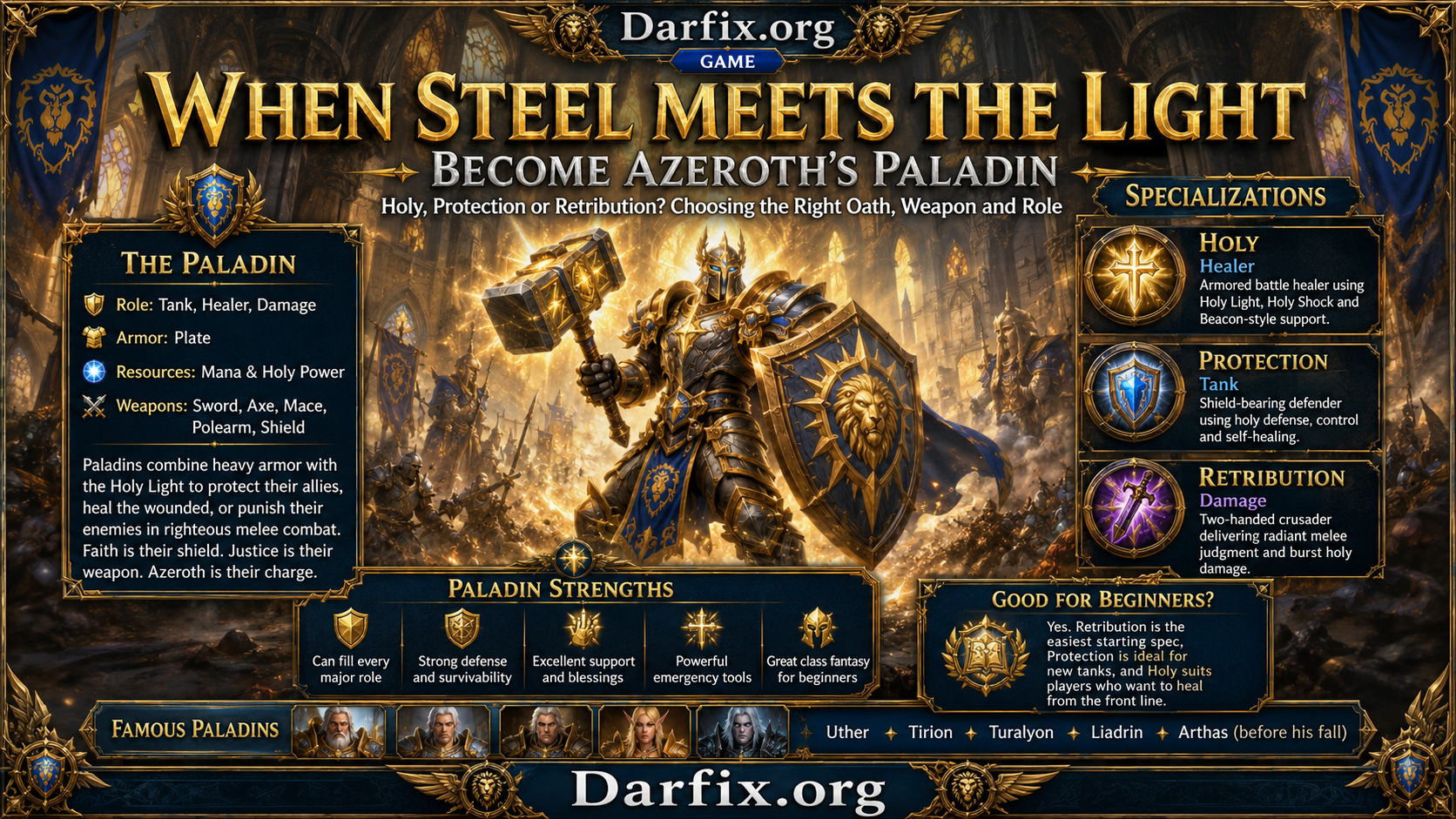
The Paladin is one of World of Warcraft’s most recognizable hybrid classes. These heavily armored champions combine martial training with the power of the Holy Light, allowing them to protect allies, restore the wounded or punish enemies in close-range combat.
Unlike a Warrior, whose strength comes primarily from weapons, armor and battlefield experience, a Paladin supports physical combat with healing magic, protective blessings, sacred shields and devastating Holy attacks.
Paladins can perform all three primary group roles: Tank, Healer and melee Damage Dealer. Holy specializes in healing, Protection defends the group and Retribution fights as a heavily armed crusader.
Paladins wear Plate armor and can equip shields. Their available weapons include swords, axes, maces and polearms, although the ideal choice depends on the selected Specialization.
Holy usually fights with a one-handed sword or mace and a shield. Protection uses a one-handed weapon and shield, while Retribution normally carries a powerful two-handed sword, axe or mace.
The Paladin’s primary resources are Mana and Holy Power. Mana is mainly associated with spells and healing, while Holy Power is generated through specific abilities and spent on stronger attacks, healing effects or defensive actions.
This creates a clear combat rhythm. The Paladin first uses abilities that build Holy Power and then decides whether to spend that resource on damage, survival or healing.
Paladins are also known for their Blessings and Auras. These abilities can protect individual allies, improve group survival and provide valuable support during difficult encounters.
Holy Paladin
Holy is the Paladin’s healing Specialization. It uses the Light to restore health, prevent deaths and protect allies during dangerous combat situations.
Unlike many traditional healers who remain far behind the group, Holy Paladins wear Plate armor and can operate closer to the frontline. This gives them the visual and mechanical identity of an armored battle healer.
Holy Shock is one of the Specialization’s most recognizable abilities. It can quickly heal an ally or damage an enemy while contributing to the Paladin’s resource cycle.
Word of Glory provides strong healing by spending Holy Power. Light of Dawn can restore health to several nearby allies, making positioning important during group encounters.
Beacon of Light allows the Paladin to create a special connection with an ally, often the Tank. Certain healing effects directed at other players can also benefit the Beacon target.
Holy Paladins are particularly effective at supporting important individual targets. Their direct healing, emergency abilities and powerful defensive tools can help save allies who are close to death.
The Specialization is suitable for players who enjoy:
• Healing while wearing heavy armor
• Supporting the group from near the frontline
• Protecting important individual targets
• Managing Mana and Holy Power
• Responding quickly to sudden damage
• Using powerful emergency abilities
Holy can be approachable for players who already understand basic healing, but beginners must learn to monitor the entire group while also remaining aware of their own position.
Because many Paladin abilities work best at limited range, standing too far from allies can reduce effectiveness. The player must remain close enough to heal while avoiding dangerous enemy attacks.
Protection Paladin
Protection is the Paladin’s Tank Specialization. It uses a one-handed weapon, a shield and Holy magic to attract enemy attention and defend the rest of the group.
Protection Paladins create a strong fortress-like presence on the battlefield. Their shields block physical attacks, while sacred abilities reduce damage, interrupt enemies and protect nearby allies.
Avenger’s Shield is one of the Specialization’s signature abilities. The Paladin throws a magical shield toward enemies, damaging them and disrupting spellcasting before the shield can continue toward additional targets.
Shield of the Righteous spends Holy Power to strengthen the Paladin’s defenses while striking nearby enemies. Correctly managing this ability is important when facing strong physical attacks.
Consecration covers the ground around the Paladin with Holy energy. Protection Paladins often fight inside this area to improve their control and survival.
Word of Glory can provide important self-healing, especially after the Paladin has suffered heavy damage. This gives Protection a strong ability to recover without depending entirely on the group’s Healer.
Protection Paladins also have access to several emergency defensive abilities. These tools can reduce incoming damage, prevent death or temporarily make the character extremely difficult to defeat.
The Specialization is suitable for players who enjoy:
• Carrying a sword and shield
• Leading dungeon groups
• Controlling several enemies
• Interrupting dangerous spells
• Combining defense with self-healing
• Protecting allies with emergency abilities
Protection is a strong Tank for players who like having many support tools. The Paladin can protect teammates, heal in emergencies and respond to threats that extend beyond personal survival.
However, Tanking requires responsibility. Protection players must understand enemy positioning, dungeon routes, defensive timing and how many opponents the group can safely fight.
A beginner interested in Protection should first practise during quests and easier dungeons. Learning the purpose of each defensive ability is more important than immediately entering difficult content.
Retribution Paladin
Retribution is the Paladin’s melee Damage Specialization. It combines heavy two-handed weapons with Holy magic to judge and punish enemies.
Retribution creates the fantasy of a righteous crusader entering battle with a glowing sword, axe or hammer. Its attacks often produce bright explosions of Holy energy rather than relying only on physical weapon damage.
The Specialization builds Holy Power through abilities such as Judgment and other weapon-based attacks. That resource can then be spent on powerful finishing abilities.
Templar’s Verdict is an important single-target Holy Power spender. It delivers a heavy attack against one enemy and represents the Specialization’s focus on decisive punishment.
Divine Storm attacks several nearby enemies, making it useful when fighting groups. Retribution players must decide whether their Holy Power should be spent on concentrated single-target damage or broader area attacks.
Avenging Wrath is one of the Paladin’s most iconic abilities. The character manifests radiant wings and temporarily becomes significantly more powerful.
Retribution also retains access to valuable Paladin support tools. A skilled player can protect an ally, remove a harmful effect or provide emergency healing without abandoning the Damage role.
The Specialization is suitable for players who enjoy:
• Large two-handed weapons
• Holy melee attacks
• Strong visual effects
• Building and spending Holy Power
• Dealing both single-target and area damage
• Supporting allies while remaining a Damage Dealer
Retribution is generally a good Paladin Specialization for beginners. Its core fantasy is immediately understandable, its armor provides useful durability and its support abilities can correct mistakes during solo play.
Players must still learn when to use their strongest attacks, how to avoid wasting Holy Power and when sacrificing a small amount of damage to protect an ally is worthwhile.
Paladin Strengths
Versatility is one of the Paladin’s greatest strengths. A single character can switch between Tank, Healer and Damage Specializations rather than being permanently limited to one group role.
Plate armor and defensive abilities make Paladins difficult to defeat. Even Retribution and Holy can survive situations that might quickly overwhelm more fragile classes.
Paladins possess exceptional emergency tools. They can reduce damage, protect allies, remove harmful effects, restore large amounts of health and sometimes prevent an otherwise certain death.
Blessings give the class valuable group utility. A Paladin is not useful only because of personal damage, healing or defense; the class can also improve the survival and freedom of other players.
Paladins are also particularly effective against undead and demonic themes from a class-fantasy perspective. Their glowing weapons, sacred symbols and Light-based attacks create a strong contrast with the darker forces of Azeroth.
Paladin Weaknesses
Paladins are generally less mobile than classes such as Demon Hunter, Monk or Warrior. They have movement tools, but cannot constantly leap, dash or charge across the battlefield.
Most Retribution and Protection attacks require close range. Encounters that repeatedly force the Paladin away from an enemy can interrupt combat and reduce effectiveness.
The class possesses many situational support abilities. This is a major strength, but beginners may initially feel overwhelmed by the number of Blessings, defensive cooldowns, healing spells and utility buttons.
Holy Paladins must balance healing resources carefully. Spending too much Mana early in a long encounter can leave the player unable to respond later.
Protection Paladins can survive considerable damage, but poor management of Holy Power or defensive abilities can create sudden moments of vulnerability.
Paladin in Solo Content
Paladins are excellent for quests, exploration and open-world activities because they combine damage, armor and self-healing.
Retribution is usually the fastest and most straightforward choice for solo content. It can defeat enemies efficiently while using healing and defensive abilities when necessary.
Protection can safely fight large groups of ordinary enemies, although defeating individual targets may take longer. Its survivability makes it useful in dangerous areas.
Holy can complete solo content, but its primary design is focused on healing. Players usually switch to Retribution when completing quests alone and return to Holy for group activities.
Paladin in Dungeons and Raids
Holy Paladins heal the group, protect important targets and use emergency abilities during periods of intense damage.
Protection Paladins lead enemies, maintain threat, interrupt spells and use defensive abilities before powerful attacks reach them.
Retribution Paladins fight in melee range, damage priority targets and provide additional support through Blessings, healing and defensive utility.
A skilled Paladin pays attention to more than personal performance. Saving another player with the correct Blessing can sometimes contribute more to victory than using one additional damage ability.
Paladin in PvP
Paladins can be extremely difficult opponents in Player-versus-Player combat because they combine offensive pressure with healing, immunities and defensive support.
Retribution attempts to create powerful moments of burst damage while using support abilities to remain in combat.
Holy provides durable healing and can be difficult to remove from a fight without coordinated enemy pressure.
Protection emphasizes survival, disruption and protecting teammates, although its place in competitive PvP can vary between updates.
Paladins can remove certain movement restrictions, protect teammates from physical attacks and use powerful defensive cooldowns to survive moments that would defeat many other classes.
However, experienced opponents may attempt to force the Paladin to use important defensive abilities early. Once those abilities are unavailable, the character becomes easier to pressure.
Famous Paladins in Warcraft
Uther the Lightbringer is one of the most important Paladins in Warcraft history. He served as a legendary member of the Knights of the Silver Hand and attempted to guide Prince Arthas before Arthas fell to darkness.
Tirion Fordring became one of Azeroth’s greatest champions. He led the Argent Crusade against the Lich King and carried the legendary Ashbringer.
Turalyon fought during the Second War and later became one of the most important military and religious leaders associated with the Alliance and the Army of the Light.
Lady Liadrin leads the Blood Knights, the Blood Elf order of Paladins. Her story demonstrates that devotion to the Light is not limited to the traditional human kingdoms of the Alliance.
Arator is the son of Turalyon and Alleria Windrunner. He follows the path of the Paladin while carrying the legacy of two very different worlds and families.
Arthas Menethil began his story as a Human Paladin trained by Uther. His transformation into a Death Knight and eventually the Lich King became one of Warcraft’s greatest tragedies.
Is Paladin Good for Beginners?
Yes. Paladin is an excellent beginner class for players who want heavy armor, clear class identity and the freedom to experiment with every primary group role.
Retribution is usually the easiest starting Specialization because it offers direct melee combat, strong defensive tools and reliable self-healing.
Protection is suitable for players who want to Tank and are prepared to learn group leadership, enemy positioning and defensive timing.
Holy is appropriate for players who enjoy watching over teammates and reacting to incoming damage, but healing requires greater awareness of the entire group.
The best first Specialization depends on the desired experience:
Choose Holy to heal and protect allies.
Choose Protection to lead the group and stand between enemies and teammates.
Choose Retribution to carry a two-handed weapon and deliver Holy judgment in melee combat.
The Paladin is ultimately defined by responsibility. Its power is not granted only to defeat enemies, but to decide when to heal, when to defend and when justice demands a direct strike.
Unlike a Warrior, whose strength comes primarily from weapons, armor and battlefield experience, a Paladin supports physical combat with healing magic, protective blessings, sacred shields and devastating Holy attacks.
Paladins can perform all three primary group roles: Tank, Healer and melee Damage Dealer. Holy specializes in healing, Protection defends the group and Retribution fights as a heavily armed crusader.
Paladins wear Plate armor and can equip shields. Their available weapons include swords, axes, maces and polearms, although the ideal choice depends on the selected Specialization.
Holy usually fights with a one-handed sword or mace and a shield. Protection uses a one-handed weapon and shield, while Retribution normally carries a powerful two-handed sword, axe or mace.
The Paladin’s primary resources are Mana and Holy Power. Mana is mainly associated with spells and healing, while Holy Power is generated through specific abilities and spent on stronger attacks, healing effects or defensive actions.
This creates a clear combat rhythm. The Paladin first uses abilities that build Holy Power and then decides whether to spend that resource on damage, survival or healing.
Paladins are also known for their Blessings and Auras. These abilities can protect individual allies, improve group survival and provide valuable support during difficult encounters.
Holy Paladin
Holy is the Paladin’s healing Specialization. It uses the Light to restore health, prevent deaths and protect allies during dangerous combat situations.
Unlike many traditional healers who remain far behind the group, Holy Paladins wear Plate armor and can operate closer to the frontline. This gives them the visual and mechanical identity of an armored battle healer.
Holy Shock is one of the Specialization’s most recognizable abilities. It can quickly heal an ally or damage an enemy while contributing to the Paladin’s resource cycle.
Word of Glory provides strong healing by spending Holy Power. Light of Dawn can restore health to several nearby allies, making positioning important during group encounters.
Beacon of Light allows the Paladin to create a special connection with an ally, often the Tank. Certain healing effects directed at other players can also benefit the Beacon target.
Holy Paladins are particularly effective at supporting important individual targets. Their direct healing, emergency abilities and powerful defensive tools can help save allies who are close to death.
The Specialization is suitable for players who enjoy:
• Healing while wearing heavy armor
• Supporting the group from near the frontline
• Protecting important individual targets
• Managing Mana and Holy Power
• Responding quickly to sudden damage
• Using powerful emergency abilities
Holy can be approachable for players who already understand basic healing, but beginners must learn to monitor the entire group while also remaining aware of their own position.
Because many Paladin abilities work best at limited range, standing too far from allies can reduce effectiveness. The player must remain close enough to heal while avoiding dangerous enemy attacks.
Protection Paladin
Protection is the Paladin’s Tank Specialization. It uses a one-handed weapon, a shield and Holy magic to attract enemy attention and defend the rest of the group.
Protection Paladins create a strong fortress-like presence on the battlefield. Their shields block physical attacks, while sacred abilities reduce damage, interrupt enemies and protect nearby allies.
Avenger’s Shield is one of the Specialization’s signature abilities. The Paladin throws a magical shield toward enemies, damaging them and disrupting spellcasting before the shield can continue toward additional targets.
Shield of the Righteous spends Holy Power to strengthen the Paladin’s defenses while striking nearby enemies. Correctly managing this ability is important when facing strong physical attacks.
Consecration covers the ground around the Paladin with Holy energy. Protection Paladins often fight inside this area to improve their control and survival.
Word of Glory can provide important self-healing, especially after the Paladin has suffered heavy damage. This gives Protection a strong ability to recover without depending entirely on the group’s Healer.
Protection Paladins also have access to several emergency defensive abilities. These tools can reduce incoming damage, prevent death or temporarily make the character extremely difficult to defeat.
The Specialization is suitable for players who enjoy:
• Carrying a sword and shield
• Leading dungeon groups
• Controlling several enemies
• Interrupting dangerous spells
• Combining defense with self-healing
• Protecting allies with emergency abilities
Protection is a strong Tank for players who like having many support tools. The Paladin can protect teammates, heal in emergencies and respond to threats that extend beyond personal survival.
However, Tanking requires responsibility. Protection players must understand enemy positioning, dungeon routes, defensive timing and how many opponents the group can safely fight.
A beginner interested in Protection should first practise during quests and easier dungeons. Learning the purpose of each defensive ability is more important than immediately entering difficult content.
Retribution Paladin
Retribution is the Paladin’s melee Damage Specialization. It combines heavy two-handed weapons with Holy magic to judge and punish enemies.
Retribution creates the fantasy of a righteous crusader entering battle with a glowing sword, axe or hammer. Its attacks often produce bright explosions of Holy energy rather than relying only on physical weapon damage.
The Specialization builds Holy Power through abilities such as Judgment and other weapon-based attacks. That resource can then be spent on powerful finishing abilities.
Templar’s Verdict is an important single-target Holy Power spender. It delivers a heavy attack against one enemy and represents the Specialization’s focus on decisive punishment.
Divine Storm attacks several nearby enemies, making it useful when fighting groups. Retribution players must decide whether their Holy Power should be spent on concentrated single-target damage or broader area attacks.
Avenging Wrath is one of the Paladin’s most iconic abilities. The character manifests radiant wings and temporarily becomes significantly more powerful.
Retribution also retains access to valuable Paladin support tools. A skilled player can protect an ally, remove a harmful effect or provide emergency healing without abandoning the Damage role.
The Specialization is suitable for players who enjoy:
• Large two-handed weapons
• Holy melee attacks
• Strong visual effects
• Building and spending Holy Power
• Dealing both single-target and area damage
• Supporting allies while remaining a Damage Dealer
Retribution is generally a good Paladin Specialization for beginners. Its core fantasy is immediately understandable, its armor provides useful durability and its support abilities can correct mistakes during solo play.
Players must still learn when to use their strongest attacks, how to avoid wasting Holy Power and when sacrificing a small amount of damage to protect an ally is worthwhile.
Paladin Strengths
Versatility is one of the Paladin’s greatest strengths. A single character can switch between Tank, Healer and Damage Specializations rather than being permanently limited to one group role.
Plate armor and defensive abilities make Paladins difficult to defeat. Even Retribution and Holy can survive situations that might quickly overwhelm more fragile classes.
Paladins possess exceptional emergency tools. They can reduce damage, protect allies, remove harmful effects, restore large amounts of health and sometimes prevent an otherwise certain death.
Blessings give the class valuable group utility. A Paladin is not useful only because of personal damage, healing or defense; the class can also improve the survival and freedom of other players.
Paladins are also particularly effective against undead and demonic themes from a class-fantasy perspective. Their glowing weapons, sacred symbols and Light-based attacks create a strong contrast with the darker forces of Azeroth.
Paladin Weaknesses
Paladins are generally less mobile than classes such as Demon Hunter, Monk or Warrior. They have movement tools, but cannot constantly leap, dash or charge across the battlefield.
Most Retribution and Protection attacks require close range. Encounters that repeatedly force the Paladin away from an enemy can interrupt combat and reduce effectiveness.
The class possesses many situational support abilities. This is a major strength, but beginners may initially feel overwhelmed by the number of Blessings, defensive cooldowns, healing spells and utility buttons.
Holy Paladins must balance healing resources carefully. Spending too much Mana early in a long encounter can leave the player unable to respond later.
Protection Paladins can survive considerable damage, but poor management of Holy Power or defensive abilities can create sudden moments of vulnerability.
Paladin in Solo Content
Paladins are excellent for quests, exploration and open-world activities because they combine damage, armor and self-healing.
Retribution is usually the fastest and most straightforward choice for solo content. It can defeat enemies efficiently while using healing and defensive abilities when necessary.
Protection can safely fight large groups of ordinary enemies, although defeating individual targets may take longer. Its survivability makes it useful in dangerous areas.
Holy can complete solo content, but its primary design is focused on healing. Players usually switch to Retribution when completing quests alone and return to Holy for group activities.
Paladin in Dungeons and Raids
Holy Paladins heal the group, protect important targets and use emergency abilities during periods of intense damage.
Protection Paladins lead enemies, maintain threat, interrupt spells and use defensive abilities before powerful attacks reach them.
Retribution Paladins fight in melee range, damage priority targets and provide additional support through Blessings, healing and defensive utility.
A skilled Paladin pays attention to more than personal performance. Saving another player with the correct Blessing can sometimes contribute more to victory than using one additional damage ability.
Paladin in PvP
Paladins can be extremely difficult opponents in Player-versus-Player combat because they combine offensive pressure with healing, immunities and defensive support.
Retribution attempts to create powerful moments of burst damage while using support abilities to remain in combat.
Holy provides durable healing and can be difficult to remove from a fight without coordinated enemy pressure.
Protection emphasizes survival, disruption and protecting teammates, although its place in competitive PvP can vary between updates.
Paladins can remove certain movement restrictions, protect teammates from physical attacks and use powerful defensive cooldowns to survive moments that would defeat many other classes.
However, experienced opponents may attempt to force the Paladin to use important defensive abilities early. Once those abilities are unavailable, the character becomes easier to pressure.
Famous Paladins in Warcraft
Uther the Lightbringer is one of the most important Paladins in Warcraft history. He served as a legendary member of the Knights of the Silver Hand and attempted to guide Prince Arthas before Arthas fell to darkness.
Tirion Fordring became one of Azeroth’s greatest champions. He led the Argent Crusade against the Lich King and carried the legendary Ashbringer.
Turalyon fought during the Second War and later became one of the most important military and religious leaders associated with the Alliance and the Army of the Light.
Lady Liadrin leads the Blood Knights, the Blood Elf order of Paladins. Her story demonstrates that devotion to the Light is not limited to the traditional human kingdoms of the Alliance.
Arator is the son of Turalyon and Alleria Windrunner. He follows the path of the Paladin while carrying the legacy of two very different worlds and families.
Arthas Menethil began his story as a Human Paladin trained by Uther. His transformation into a Death Knight and eventually the Lich King became one of Warcraft’s greatest tragedies.
Is Paladin Good for Beginners?
Yes. Paladin is an excellent beginner class for players who want heavy armor, clear class identity and the freedom to experiment with every primary group role.
Retribution is usually the easiest starting Specialization because it offers direct melee combat, strong defensive tools and reliable self-healing.
Protection is suitable for players who want to Tank and are prepared to learn group leadership, enemy positioning and defensive timing.
Holy is appropriate for players who enjoy watching over teammates and reacting to incoming damage, but healing requires greater awareness of the entire group.
The best first Specialization depends on the desired experience:
Choose Holy to heal and protect allies.
Choose Protection to lead the group and stand between enemies and teammates.
Choose Retribution to carry a two-handed weapon and deliver Holy judgment in melee combat.
The Paladin is ultimately defined by responsibility. Its power is not granted only to defeat enemies, but to decide when to heal, when to defend and when justice demands a direct strike.