NVIDIA Expands AI Factory Vision With Spectrum-6 Networking for Gigascale Computing - Darfix
Technology2 views2026-07-23
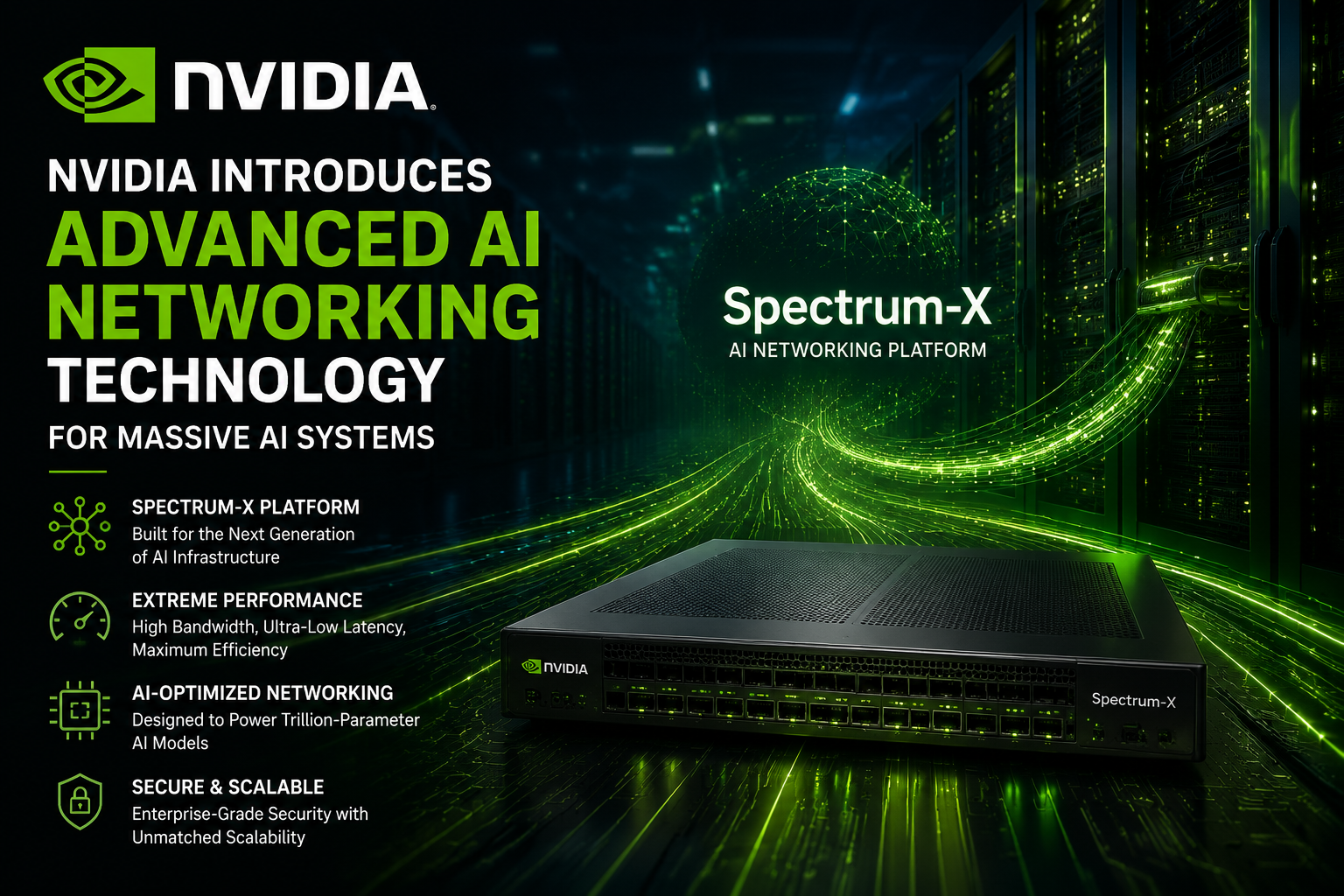
NVIDIA has unveiled Spectrum-6, a next-generation networking platform engineered for the growing demands of gigascale artificial intelligence infrastructure. The announcement represents another step in the company's long-term strategy of building complete AI factories rather than simply supplying GPUs.
Modern AI models require thousands of processors to communicate with extremely low latency while transferring enormous volumes of data. Spectrum-6 is designed to improve this communication layer, helping AI clusters scale more efficiently and reducing network bottlenecks during training and inference.
The new platform is expected to work alongside NVIDIA's Vera Rubin architecture, enabling cloud providers and enterprise customers to build larger AI systems capable of serving advanced foundation models and autonomous AI agents.
According to NVIDIA, AI factories will become the industrial backbone of the next generation of digital services. Instead of focusing only on raw computing power, the company is investing heavily in networking, storage and software to optimize every layer of AI infrastructure.
Spectrum-6 introduces faster switching technologies and improved bandwidth efficiency, allowing hundreds of thousands of GPUs to operate together across massive data centers. These improvements are expected to benefit industries including healthcare, financial services, robotics, scientific research and autonomous transportation.
The announcement also reflects the growing competition among technology companies building infrastructure for generative AI. As demand for larger language models and enterprise AI continues to increase, networking performance has become nearly as important as GPU performance itself.
Industry analysts believe that next-generation networking solutions will play a major role in reducing operational costs while increasing AI productivity, making large-scale deployments more practical for cloud providers and enterprise organizations.
With Spectrum-6, NVIDIA continues positioning itself as a full-stack AI infrastructure company, offering processors, networking, software and developer platforms designed to power the next wave of intelligent applications.
Modern AI models require thousands of processors to communicate with extremely low latency while transferring enormous volumes of data. Spectrum-6 is designed to improve this communication layer, helping AI clusters scale more efficiently and reducing network bottlenecks during training and inference.
The new platform is expected to work alongside NVIDIA's Vera Rubin architecture, enabling cloud providers and enterprise customers to build larger AI systems capable of serving advanced foundation models and autonomous AI agents.
According to NVIDIA, AI factories will become the industrial backbone of the next generation of digital services. Instead of focusing only on raw computing power, the company is investing heavily in networking, storage and software to optimize every layer of AI infrastructure.
Spectrum-6 introduces faster switching technologies and improved bandwidth efficiency, allowing hundreds of thousands of GPUs to operate together across massive data centers. These improvements are expected to benefit industries including healthcare, financial services, robotics, scientific research and autonomous transportation.
The announcement also reflects the growing competition among technology companies building infrastructure for generative AI. As demand for larger language models and enterprise AI continues to increase, networking performance has become nearly as important as GPU performance itself.
Industry analysts believe that next-generation networking solutions will play a major role in reducing operational costs while increasing AI productivity, making large-scale deployments more practical for cloud providers and enterprise organizations.
With Spectrum-6, NVIDIA continues positioning itself as a full-stack AI infrastructure company, offering processors, networking, software and developer platforms designed to power the next wave of intelligent applications.